
Every nurse remembers the moment fundamentals stopped feeling like theory and started feeling like the real thing. The moment you realized that hand hygiene is not a rule someone made up — it is the difference between a patient who goes home and one who develops a hospital-acquired infection. The moment you understood that therapeutic communication is not a soft skill — it is how you build the trust that makes every other nursing intervention possible. The moment the nursing process stopped being a five-step academic framework and became the way you actually think at the bedside.
Wilkinson’s Fundamentals of Nursing has been helping students reach that moment for years. The 5th edition, now carried forward by Leslie Treas, Karen Barnett, and Mable Smith through F.A. Davis and the Davis Advantage learning platform, continues the tradition of grounding fundamental nursing knowledge in theory that is immediately visible in clinical practice. Volume 1 covers the conceptual and foundational content — the building blocks that everything in nursing education and nursing practice stands on.
This test bank was built to match it. Every question is grounded in the theoretical frameworks, conceptual underpinnings, and clinical applications of the 5th edition. You do not just learn what to do as a nurse. You practice understanding why — and that understanding is what transforms a student into a clinician.
Table of Contents
UNIT 1: How Nurses Think
- Chapter 1: Nursing Past and Present
- Chapter 2: Critical Thinking and Clinical Judgment
- Chapter 3: Nursing Process: Assessment
- Chapter 4: Nursing Process: Diagnosis
- Chapter 5: Nursing Process: Planning Outcomes
- Chapter 6: Nursing Process: Planning Interventions
- Chapter 7: Nursing Process: Implementation and Evaluation
- Chapter 8: Nursing Theory and Research
- Chapter 9: Evidence-Based Practice
UNIT 2: Factors Affecting Health
- Chapter 10: Life Span Development
- Chapter 11: Experiencing Health and Illness
- Chapter 12: Promoting Health
- Chapter 13: Culture and Ethnicity
- Chapter 14: Spirituality
- Chapter 15: Loss, Grief, and Dying
UNIT 3: The Nursing Process in Context
- Chapter 16: Communication
- Chapter 17: Documenting and Reporting
- Chapter 18: Ethical Knowledge Development
- Chapter 19: Legal Knowledge Development
- Chapter 20: Nursing Informatics and Technology
UNIT 4: How Nurses Support Psychosocial Health
- Chapter 21: Stress and Adaptation
- Chapter 22: Psychosocial Health and Illness
- Chapter 23: Sexual Health and Sexuality
- Chapter 24: Family Health
UNIT 5: Essential Nursing Interventions
- Chapter 25: Asepsis and Infection Control
- Chapter 26: Safety
- Chapter 27: Hygiene
- Chapter 28: Skin Integrity and Wound Care
- Chapter 29: Activity and Exercise
- Chapter 30: Sleep and Rest
- Chapter 31: Nutrition
- Chapter 32: Urinary Elimination
- Chapter 33: Bowel Elimination
- Chapter 34: Sensation, Perception, and Cognition
- Chapter 35: Pain Management
- Chapter 36: Medication Administration
- Chapter 37: Perioperative Nursing
UNIT 6: Supporting Physiological Health
- Chapter 38: Oxygenation
- Chapter 39: Circulation
- Chapter 40: Fluid, Electrolyte, and Acid-Base Balance
- Chapter 41: Nutrition (Advanced)
- Chapter 42: Urinary Elimination (Advanced)
- Chapter 43: Bowel Elimination (Advanced)
- Chapter 44: Sensory Perception
- Chapter 45: Mobility
- Chapter 46: Skin Integrity and Wound Healing (Advanced)
UNIT 7: Skills for Fundamentals of Nursing
- Chapter 47: Vital Signs
- Chapter 48: Health Assessment
- Chapter 49: Specimen Collection
- Chapter 50: Diagnostic Testing
What Is Inside
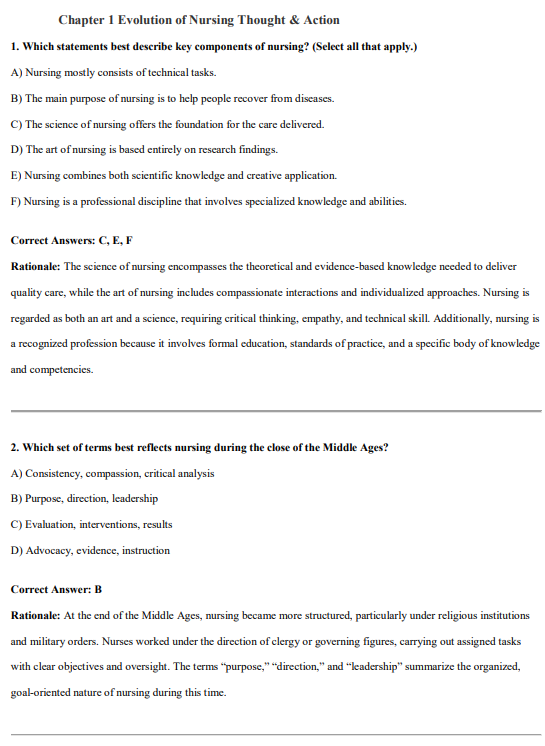
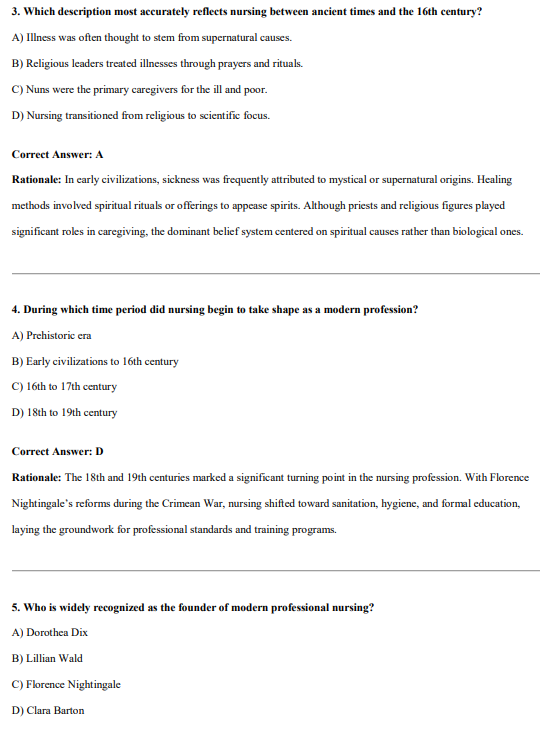
You get over a thousand practice questions covering every major conceptual and foundational topic in Volume 1 of Treas, Barnett, and Smith’s 5th edition. Questions are written in multiple-choice, select-all-that-apply, and ordered response formats — consistent with what you will encounter on nursing school exams and the NCLEX-RN and NCLEX-PN.
Every question has a clearly marked correct answer. Every answer includes a full written rationale. The rationale explains the nursing theory, conceptual framework, clinical principle, or evidence-based standard behind the correct choice and addresses why each wrong option reflects a misunderstanding of the foundational concept being tested. In fundamentals nursing, the rationale is where the theory becomes practice — and this test bank is designed to make that transition explicit with every single answer.
Topics Covered
The test bank follows the complete structure of Volume 1 of the 5th edition across every major foundational and conceptual content area, including:
The Nurse and the Healthcare System — the history and evolution of nursing as a profession, nursing’s social policy statement and scope of practice, roles and functions of the professional nurse, the healthcare delivery system and its structure, types of healthcare settings and their nursing implications, interprofessional collaboration and team-based care, the impact of economics on healthcare and nursing, health disparities and the social determinants of health, and health policy and the nurse’s role in advocacy
Nursing Theory and the Nursing Process — overview of major nursing theories including Florence Nightingale, Virginia Henderson, Dorothea Orem, Martha Rogers, Betty Neuman, and Jean Watson, the relationship between nursing theory and practice, the nursing process as a systematic framework including assessment, diagnosis, planning, implementation, and evaluation, NANDA-I nursing diagnoses and their application, nursing outcomes classification and nursing interventions classification, clinical judgment and its relationship to the nursing process, and critical thinking in nursing practice
Legal and Ethical Foundations — sources of law applicable to nursing practice, nursing licensure and the nurse practice act, types of liability including negligence and malpractice, elements of malpractice and nursing documentation as a legal record, patient rights and the Patient’s Bill of Rights, informed consent and the nurse’s role, advance directives and end-of-life decision-making, mandatory reporting obligations, ethical theories and principles including autonomy, beneficence, nonmaleficence, and justice, the ANA Code of Ethics, ethical decision-making frameworks, and navigating ethical dilemmas in clinical practice
Communication in Nursing — therapeutic communication principles and techniques, barriers to effective communication, active listening and attending skills, assertive communication in professional nursing, verbal and nonverbal communication, written and electronic communication in nursing including documentation, SBAR for clinical handoffs and provider communication, communication across developmental stages, culturally responsive communication, communication with patients who have communication barriers, and the nurse-patient relationship including phases and boundaries
Cultural Humility and Patient-Centered Care — cultural humility as a framework versus cultural competence, dimensions of culture and their health implications, health disparities and structural racism in healthcare, culturally responsive assessment, religious and spiritual dimensions of health, and patient-centered care as a core nursing value
Patient Education — principles of adult learning theory, assessing patient and family learning needs and readiness, barriers to learning, health literacy and its clinical implications, developing a patient education plan, teaching strategies across learning styles, documentation of patient education, and evaluating the effectiveness of teaching
Documentation and Informatics — principles of nursing documentation, types of nursing records including narrative, SOAP, PIE, and focus charting, electronic health records and the nurse’s role, meaningful use and informatics competencies, nursing informatics as a specialty, confidentiality and privacy in documentation, and legal implications of nursing records
Health Assessment Foundations — the health history and its components, cultural and developmental considerations in health assessment, techniques of physical examination including inspection, palpation, percussion, and auscultation, preparation of the patient and environment for assessment, and documentation of assessment findings
Vital Signs — temperature measurement including routes and normal values, pulse assessment including rate, rhythm, and quality, respiratory rate and character assessment, blood pressure measurement techniques and normal values across the lifespan, oxygen saturation monitoring, pain as the fifth vital sign, factors affecting vital signs, and abnormal vital sign findings and their clinical significance
Infection Control and Asepsis — chain of infection and the nurse’s role in breaking it, types of microorganisms and their transmission, surgical and medical asepsis principles, the surgical conscience, standard precautions and transmission-based precautions including contact, droplet, and airborne isolation, personal protective equipment selection and donning and doffing technique, hand hygiene including handwashing and alcohol-based handrub, healthcare-associated infections and prevention strategies, and OSHA bloodborne pathogen standards
Safety — patient safety as a nursing priority, fall risk assessment and prevention, restraint use and alternatives, environmental safety, fire safety in healthcare settings, electrical and radiation safety, medication safety and the rights of medication administration, National Patient Safety Goals and their nursing implications, safe patient handling principles, and the nurse’s role in reporting errors and near-misses
Hygiene and Personal Care — oral hygiene for various patient populations, hair care, eye and ear care, skin care and bathing techniques, perineal care, nail care, and bed making
Activity, Mobility, and Exercise — the physiology of movement, effects of immobility on every body system, range of motion exercises, positioning and repositioning, transfer techniques and safe patient handling, ambulation assistance, and nursing care for patients with mobility impairments
Sleep and Rest — physiology of sleep and sleep stages, factors affecting sleep quality, common sleep disorders including insomnia and sleep apnea, nursing assessment of sleep, and non-pharmacologic and pharmacologic approaches to promoting sleep
Nutrition — macronutrient and micronutrient requirements, nutritional assessment including anthropometric and dietary measurement, therapeutic diets and their nursing implications, dysphagia assessment and safe feeding, enteral nutrition initiation and management, parenteral nutrition nursing care, and malnutrition recognition in hospitalized patients
Fluid and Electrolyte Balance — body fluid compartments and distribution, mechanisms of fluid movement including osmosis and diffusion, fluid imbalances including dehydration and fluid volume excess, electrolyte imbalances including sodium, potassium, calcium, and magnesium disorders, intravenous fluid types and their clinical indications, intravenous therapy nursing care including site assessment and complication recognition, and acid-base balance overview
Elimination — normal bowel and urinary elimination patterns, factors affecting elimination, urinary incontinence types and nursing management, urinary catheterization including straight and indwelling catheter technique, catheter care and catheter-associated urinary tract infection prevention, constipation and diarrhea assessment and nursing management, ostomy care and education, and documentation of elimination
Medication Administration Foundations — pharmacokinetic principles for nursing, medication reconciliation, the rights of medication administration, medication error prevention, safe handling of medications including controlled substances, drug calculations and dosage calculation principles, and medication administration route principles including oral, topical, and parenteral
Pain Assessment and Management — pain physiology and types of pain, the subjective nature of pain and the patient as the authority on their own pain, pain assessment tools for various patient populations, barriers to adequate pain management, pharmacologic pain management principles, non-pharmacologic pain relief strategies, and documentation of pain assessment and response to treatment
Perioperative Nursing Fundamentals — preoperative nursing assessment and patient preparation, informed consent and surgical safety, intraoperative nursing responsibilities overview, postoperative nursing assessment and monitoring, management of common postoperative complications, and discharge planning following surgery
Loss, Grief, and End-of-Life Care — theoretical models of grief including Kübler-Ross and Worden, types of loss and grief responses, nursing assessment of grief, therapeutic communication with grieving patients and families, advance care planning and advance directives, hospice and palliative care principles, postmortem care, and supporting families through the dying process
Who Should Use This
This test bank is well suited for nursing students in their first or second semester whose fundamentals course uses Wilkinson’s 5th edition Volume 1, students using the Davis Advantage platform who want additional question-based practice to complement the adaptive quizzing and learning modules the platform provides, NCLEX-PN candidates who want structured practice across all major foundational nursing content areas, NCLEX-RN candidates who want to reinforce their foundational nursing knowledge before moving into more advanced clinical content, students who are struggling with the theoretical foundations of nursing and need application-level questions to connect theory to clinical practice, and nursing faculty teaching fundamentals courses who need a comprehensive, theoretically grounded question pool for building unit exams, quizzes, and comprehensive assessments.
Why the 5th Edition Specifically
The 5th edition of Wilkinson’s Fundamentals, now authored by Treas, Barnett, and Smith, has been updated to reflect current evidence-based nursing practice, revised clinical guidelines, expanded coverage of health equity and social determinants of health, stronger integration of the clinical judgment framework that the Next Generation NCLEX demands, and deeper alignment with the Davis Advantage adaptive learning platform’s approach to building nursing competency progressively.
This test bank was written to align with the 5th edition specifically — including its updated foundational content, revised conceptual frameworks, and clinical application examples. If your program uses the 5th edition, this is the resource that fits it directly.
5 Sample Questions
Question 1
A nursing student is preparing to perform a focused assessment on a newly admitted patient and reviews the patient’s electronic health record beforehand. The student identifies that the patient has a documented allergy to penicillin but notes that the physician has ordered amoxicillin. Using the nursing process, which action by the student best reflects appropriate use of the assessment phase?
A. Administer the amoxicillin since the physician reviewed the chart before ordering it and is ultimately responsible for prescribing decisions
B. Recognize that amoxicillin is a penicillin-type antibiotic, hold the medication, and immediately notify the supervising nurse and prescribing provider of the allergy conflict
C. Ask the patient whether they have actually taken amoxicillin before and if they tolerated it, then administer if the patient reports no prior reaction
D. Document the allergy in the nursing notes and proceed with medication administration since the responsibility for allergy checking belongs to the pharmacy
Correct Answer: B
The assessment phase of the nursing process includes gathering, validating, and interpreting patient data — and acting on information that indicates a patient safety risk. Amoxicillin is a penicillin-type antibiotic, and a documented penicillin allergy creates a cross-reactivity risk that must be addressed before any dose is administered. The nursing student’s responsibility is to recognize the conflict, hold the medication, and immediately communicate the concern to the supervising nurse and prescriber. This is not a matter of waiting for others to catch it — medication safety is a shared professional responsibility at every level of the healthcare team. Administering a drug in the face of a known allergy conflict, regardless of who ordered it, is a patient safety failure.
Question 2
A nurse is using Jean Watson’s Theory of Human Caring to guide care for a patient who has just received a terminal cancer diagnosis. The patient is silent and tearful. Which nursing response most directly reflects the application of Watson’s theory?
A. Provide the patient with written educational materials about their diagnosis and available treatment options to support informed decision-making
B. Sit with the patient in silence, make gentle eye contact, and say: “I am here with you. You do not need to say anything right now.”
C. Notify the social worker and chaplain immediately so appropriate referrals can be made before the nurse’s next task
D. Document the patient’s emotional response and proceed with the physical assessment to stay on schedule
Correct Answer: B
Jean Watson’s Theory of Human Caring centers on the caring moment — an authentic, human-to-human encounter between the nurse and patient that transcends technical tasks and creates a healing environment. Watson’s ten carative factors include being authentically present, cultivating sensitivity to self and others, and assisting with the expression of both positive and negative feelings. A patient who has just received devastating news does not need information, referrals, or assessment — they need a human presence that communicates “you are not alone in this moment.” Sitting in silence, making eye contact, and offering a simple affirming statement is the most direct clinical application of Watson’s theory. Referrals and documentation are appropriate but secondary actions, not the primary nursing response in this moment.
Question 3
A nurse is preparing to insert an indwelling urinary catheter for a female patient. After gathering supplies and performing hand hygiene, the nurse opens the sterile kit and establishes a sterile field. While arranging items on the sterile field, the nurse’s non-sterile gloved hand inadvertently touches the edge of the sterile drape. Which action is most appropriate?
A. Continue with the procedure since the edge of the sterile drape is considered a transition zone and is not truly sterile
B. Recognize that the sterile field has been contaminated, stop the procedure, discard the kit, and obtain a new sterile catheter kit before proceeding
C. Wipe the area of contact with an alcohol swab and proceed since alcohol is a sufficient disinfectant to restore the sterile field
D. Proceed with the procedure but use extra caution to avoid touching the catheter itself with the contaminated area
Correct Answer: B
A fundamental principle of surgical asepsis is that a sterile field is contaminated the moment a non-sterile item contacts any part of it — including the edges of the sterile drape, which are considered sterile by definition in clinical practice. There is no clinical procedure to “restore” sterility to a contaminated field — alcohol disinfection does not render a field sterile. The nurse must stop, discard the contaminated kit, perform hand hygiene, and obtain a new sterile kit before proceeding. This principle — that sterile is sterile and any break in technique requires restarting — is the foundation of the surgical conscience that every nurse must internalize and uphold regardless of inconvenience or time pressure.
Question 4
A nurse is conducting a health history with a patient from a cultural background different from the nurse’s own. The patient pauses frequently before answering questions and avoids direct eye contact with the nurse. The nurse interprets the patient as being evasive and uncooperative and documents this in the nursing notes. Which nursing practice error does this situation illustrate?
A. The nurse has appropriately documented objective behavioral observations that are relevant to the patient’s care
B. The nurse has committed an ethnocentric documentation error by interpreting culturally specific communication patterns through the lens of the nurse’s own cultural norms without seeking to understand the patient’s cultural context
C. The nurse has applied cultural competence correctly by identifying that the patient’s behavior is abnormal and flagging it for further assessment
D. The nurse’s interpretation is clinically appropriate since pausing and avoiding eye contact are universal indicators of evasiveness across all cultures
Correct Answer: B
In many cultures, pausing before answering a question is a sign of respect and thoughtfulness rather than evasiveness. In many cultural contexts, avoiding direct eye contact with an authority figure is a sign of respect rather than avoidance. Interpreting these behaviors through a Western, individualistic cultural lens and documenting them as evasiveness or lack of cooperation is a textbook example of ethnocentrism — the assumption that one’s own cultural norms are the universal standard. Cultural humility requires the nurse to recognize their own cultural perspective as one lens among many, to seek understanding of the patient’s cultural context before drawing conclusions, and to document behavioral observations in objective, non-interpretive language. This error, when documented in the medical record, can bias subsequent providers against the patient and compromise care.
Question 5
A nurse is assessing an adult patient’s pain using the PQRSTU mnemonic during an initial health history. The patient describes the pain as “burning and shooting” that travels from the lower back down the right leg to the foot, rated 7 out of 10, worsened by sitting and improved by lying flat. Which component of the PQRSTU assessment is the nurse capturing when asking: “What were you doing when the pain started, and what makes it better or worse?”
A. Q — Quality, describing what the pain feels like
B. R — Region and radiation, identifying where the pain is located
C. P — Provocative and palliative factors, identifying what brings the pain on and what relieves it
D. S — Severity, rating the intensity of the pain on a numerical scale
Correct Answer: C
The PQRSTU mnemonic is a structured pain assessment framework where each letter corresponds to a dimension of the pain experience. P stands for Provocative and Palliative factors — what makes the pain worse and what makes it better. Asking what the patient was doing when the pain began and what relieves or aggravates it directly assesses these factors. Q captures the Quality or character of the pain — in this case the burning, shooting description. R captures Region and Radiation — the location in the lower back radiating down the leg to the foot. S captures Severity — the numerical rating of 7 out of 10. Understanding the mnemonic not just as a list of letters but as a clinical assessment framework is what allows nurses to conduct systematic, comprehensive pain assessments that capture the full dimensions of a patient’s pain experience.
Frequently Asked Questions
Is this the official F.A. Davis test bank for Wilkinson’s 5th edition?
No. This is an independently developed study resource based on the content of Treas, Barnett, and Smith’s 5th edition. It is not published or endorsed by F.A. Davis or the original authors. It is a supplementary exam preparation tool for nursing students and faculty.
How many questions are in the test bank?
There are over a thousand questions distributed across all major foundational and conceptual content areas in Volume 1 of the 5th edition, with strong representation in the highest-yield topics including the nursing process, infection control, medication safety, communication, fluid and electrolyte balance, and pain assessment.
Does this test bank cover Volume 2 content as well?
No. This test bank was written to align with Volume 1 of the 5th edition, which covers foundational and conceptual nursing content. Volume 2, which covers clinical skills and procedures in greater depth, would require a separate resource.
Can this test bank be used alongside the Davis Advantage platform?
Yes. The Davis Advantage platform provides adaptive quizzing and case-based learning modules that are integrated into the textbook experience. This test bank provides additional standalone question practice that complements the Davis Advantage content, offering more volume and variety of questions across every foundational topic.
I am a first-semester nursing student. Is this test bank appropriate for where I am in my education?
Yes. The test bank begins with the most foundational content — nursing history, nursing theory, the nursing process, communication, and legal and ethical foundations — and builds progressively through clinical application topics. It is designed to be worked through alongside your course, chapter by chapter, from the very beginning of nursing school.
Does every question include a rationale?
Yes, without exception. Every question has a correct answer and a full written rationale that explains the theoretical or clinical reasoning behind the correct choice and addresses why each wrong option reflects a misunderstanding of the foundational concept. In a fundamentals course where the purpose is to build lasting clinical thinking habits, the rationale is as important as the answer.
Can nursing faculty use this to build fundamentals course exams?
Yes. Questions are organized by chapter and topic, making it straightforward to build unit quizzes, concept assessments, or comprehensive examinations across all Volume 1 content areas. The questions are written at the application and analysis levels appropriate for first and second semester nursing students.
What file format is the test bank delivered in?
It comes as a digital file, typically in Word or PDF format. You can search by topic or conceptual framework, print specific chapters for focused study sessions, and access it across multiple devices. Many students find it most effective to work through the test bank chapter by chapter alongside their course reading, using it as an active learning tool rather than a last-minute exam crammer.
Is this test bank specific to the 5th edition only?
Yes. It was written to align with the conceptual frameworks, updated clinical content, health equity coverage, and Davis Advantage platform integration of the 5th edition specifically. Earlier editions have different organizational structures and do not reflect the clinical judgment framework updates that align with the Next Generation NCLEX. Always confirm your edition before purchasing.

Melania Angel –
A very very helpful study guide
Karen Njiru –
The resource makes my study sessions more productive as I can test my knowledge and review areas of weakness after every chapter.
Gerald N –
With thousands of Nclex-style questions, the test bank is worth every penny.
Peris Hart –
A much resource better than I expected
Lucas Gabriel –
The questions challenged me and enhanced my clinical reasoning skills
Mary Lincoln –
straightforward and easy to use. an excellent addition to my study routine