
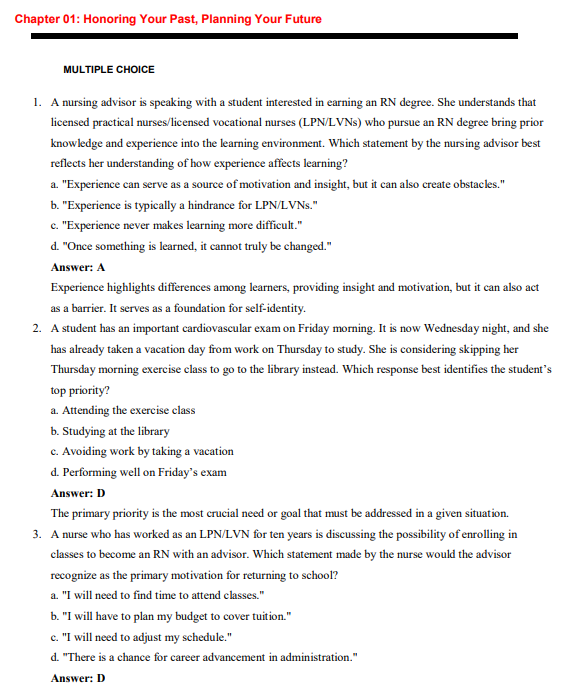

Making the jump from LPN to RN is a big step. You already have clinical experience. You know how to care for patients. But the RN role asks something different of you. It asks you to think at a higher level — to lead, to delegate, to make independent clinical judgments, and to see the full picture of patient care.
This test bank was built for that exact shift in thinking. It follows LPN to RN Transitions, 6th Edition by Lora Claywell, chapter by chapter. Every question targets the concepts, skills, and role changes you need to master to succeed as a registered nurse. Whether you are preparing for a course exam, a final, or the NCLEX-RN, this resource puts the right kind of practice in your hands.
What Is Inside
You get over a thousand practice questions drawn from every major chapter of Claywell’s 6th edition. Questions come in multiple-choice, select-all-that-apply, and ordered response formats — the same types you will face on nursing school exams and the NCLEX-RN.
Every question has a clearly marked correct answer. Every answer comes with a full rationale. The rationale does not just confirm the right choice. It walks you through the clinical reasoning behind it. That is where the real transition in thinking happens — not in memorizing facts, but in learning how an RN approaches a problem.
Topics Covered
The test bank covers every core area of the LPN to RN transition curriculum, including the differences between LPN and RN scope of practice, the nursing process and critical thinking at the RN level, leadership and management responsibilities, delegation principles and chain of command, communication and collaboration within the healthcare team, legal and ethical issues in nursing practice, professional accountability and advocacy, evidence-based practice and research literacy, cultural competence and patient-centered care, care of patients across the lifespan, pharmacology review and safe medication administration, NCLEX-RN preparation strategies, and managing career transitions in nursing.
Who Should Use This
This test bank is a strong fit for LPN-to-RN bridge students who are enrolled in a transition or mobility program, practicing LPNs who are returning to school part-time while working, nursing instructors teaching transition or mobility courses who need a solid question bank to draw from, and students preparing for the NCLEX-RN who want to focus on higher-order thinking and RN role concepts.
Why the 6th Edition Specifically
Nursing practice keeps evolving. Scope of practice guidelines get updated. Leadership expectations for new RNs shift. The 6th edition of Claywell’s text reflects those changes. This test bank was written to match it directly. If your program uses the 6th edition, this is the resource that lines up with your course material exactly.
5 Sample Questions
Question 1 An LPN-to-RN student is learning about scope of practice differences. Which action is within the RN scope but outside the LPN scope in most states?
A. Administering oral medications to a stable patient B. Performing a focused assessment on an assigned patient C. Completing an initial nursing assessment and care plan D. Reporting a change in patient condition to the physician
Correct Answer: C Initial nursing assessments and care plan development fall within the RN scope of practice. In most states, LPNs can perform focused or ongoing assessments but are not authorized to conduct the initial comprehensive assessment or independently create the nursing care plan. This distinction is central to the LPN-to-RN transition.
Question 2 A new RN is working with an LPN and an unlicensed assistive personnel (UAP). Which task is most appropriate to delegate to the UAP?
A. Evaluating a patient’s response to pain medication B. Teaching a diabetic patient how to self-administer insulin C. Measuring and recording hourly urine output for a stable patient D. Performing a dressing change on a postoperative wound
Correct Answer: C Measuring and recording urine output for a stable patient is a routine task that does not require clinical judgment and is appropriate for a UAP. Evaluation of medication response, patient teaching, and postoperative wound care all require nursing knowledge and judgment and must be performed by a licensed nurse.
Question 3 A nurse is preparing to delegate tasks at the start of a shift. Which principle should guide the nurse’s delegation decisions?
A. Delegate based on which staff member has the lightest workload B. Match the task to the education, training, and competency of the staff member C. Assign all technical tasks to the LPN to free up RN time D. Delegate any task the nurse finds inconvenient or time-consuming
Correct Answer: B Effective delegation is based on the five rights of delegation — right task, right circumstance, right person, right direction, and right supervision. The nurse must match each task to the competency and legal scope of the person receiving it. Convenience and workload alone are not valid bases for delegation decisions.
Question 4 An RN suspects that a colleague is diverting controlled substances. What is the nurse’s most appropriate first action?
A. Confront the colleague directly and ask them to stop B. Ignore it unless a patient is visibly harmed C. Report the concern through the appropriate chain of command or facility reporting process D. Document the suspicion in the patient’s medical record
Correct Answer: C Nurses have a professional and legal obligation to report suspected drug diversion. The correct step is to use the facility’s established reporting process, which may include notifying a charge nurse, supervisor, or employee health program. Confronting the colleague directly is not the appropriate first step, and documenting in a patient’s chart is not the right channel for this type of concern.
Question 5 A nurse is caring for a patient who refuses a prescribed blood transfusion due to religious beliefs. The patient is alert and oriented. What should the nurse do?
A. Proceed with the transfusion because it is medically necessary B. Notify the physician and document the patient’s refusal C. Ask the family to convince the patient to accept the treatment D. Request a psychiatric evaluation to assess decision-making capacity
Correct Answer: B A competent adult patient has the right to refuse any treatment, including life-saving interventions. The nurse’s role is to ensure the physician is notified, that the refusal is clearly documented, and that the patient understands the consequences of their decision. Overriding the refusal or pressuring the patient through family members violates patient autonomy.
Frequently Asked Questions
Is this the same as the official instructor test bank from the publisher? No. This is an independently developed study resource based on Claywell’s 6th edition content. It is not published or endorsed by Elsevier or Lora Claywell. It is a supplementary tool designed to support exam preparation and course study.
How many questions does the test bank contain? There are over a thousand questions in total. They are spread across all major chapters of the 6th edition, with more questions in chapters that cover larger content areas like delegation, scope of practice, and the nursing process.
What question formats are included? The test bank includes four-option multiple-choice questions, select-all-that-apply items, and ordered response questions. These are the same formats used on nursing school exams and the NCLEX-RN.
Can this test bank help me pass the NCLEX-RN? It is a strong preparation tool for the RN-level content the NCLEX tests. Questions are written at the application and analysis levels, which is where NCLEX-RN questions live. For best results, use it alongside a full NCLEX review program.
Is this useful if I am an experienced LPN returning to school part-time? Yes, especially so. The content focuses specifically on the shift from LPN to RN thinking — leadership, delegation, care planning, and independent judgment. It reinforces what you already know while building the skills the RN role requires.
Does each question include an answer rationale? Yes, every question does. The rationale explains why the correct answer is right and why each distractor is wrong. Reading rationales — even for questions you get right — is one of the most effective ways to strengthen your clinical reasoning.
What file format is the test bank delivered in? It comes as a digital file, usually in Word or PDF format. You can search by keyword, print individual chapters, or study from any device.
Is this test bank specific to the 6th edition only? Yes. It was written to align with the 6th edition of Claywell’s text. If your program uses the 5th edition, some content may not match. Check your course syllabus to confirm the edition before purchasing.
Dorcas M. –
Very very helpful
Maryanne –
I like it so far
Janny Cummings –
Very reliable
Peterson S. –
Helped me nail my exam
Helen Christie –
Much better than I expected
Alicia Silva –
Perfect for quick study sessions before exams.
Terence V. –
A solid addition to my nursing study routine
Lucille Maria –
Highly useful for nursing students