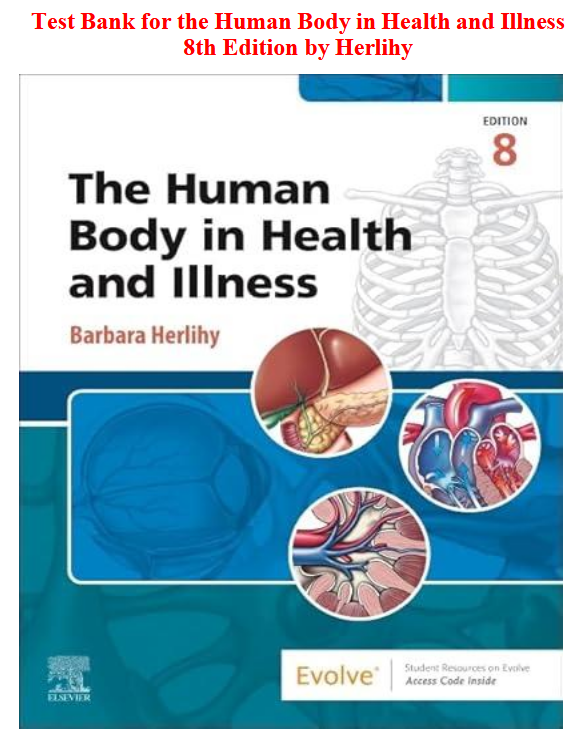
Every nursing concept you will ever learn sits on top of the same foundation — knowing how the body actually works. The 8th edition of Herlihy’s The Human Body in Health and Illness keeps doing what made the earlier editions so widely used in nursing and allied health programs: explaining anatomy and physiology in language built for future clinicians, not future researchers. It connects structure to function and function to what happens when illness disrupts it.
This edition brings updated clinical correlations, refreshed illustrations, and sharper connections between basic science and the disease processes students will spend the rest of their education studying. This test bank was built around that same approach. Every question links a body system concept to a clinical scenario, so you are not just memorizing structures — you are learning to think the way a future nurse needs to think.
What Is Inside
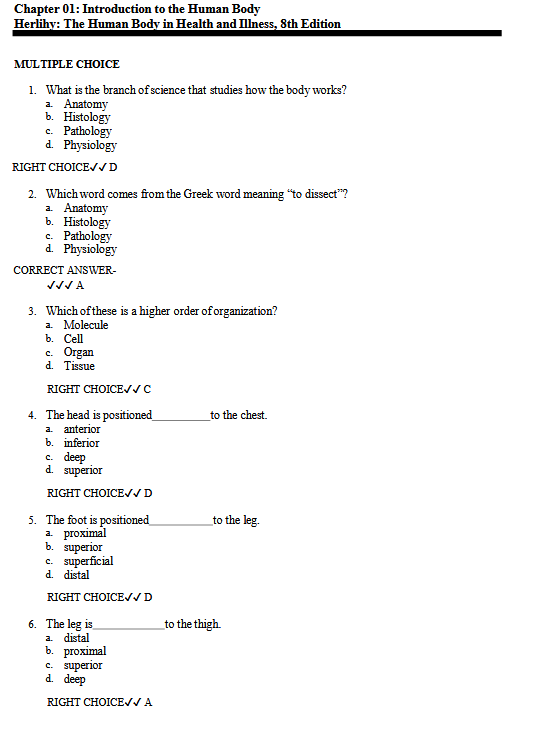
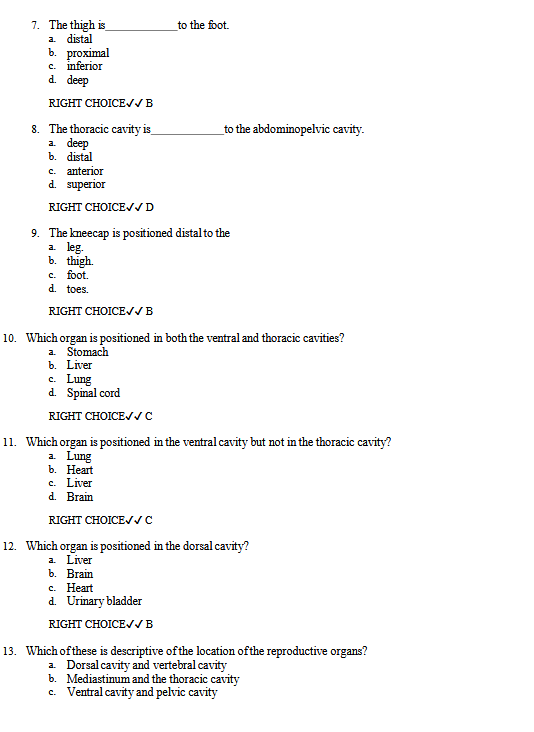
You get over a thousand practice questions spanning every body system and foundational concept in the 8th edition. Questions come in multiple-choice, true or false, matching, and fill-in-the-blank formats, mirroring the range of question types used in anatomy and physiology courses for nursing and allied health students.
Every question has a clearly marked correct answer and a full written rationale. The rationale explains the underlying anatomical or physiological principle and, where relevant, connects it to a clinical application — so you build both the science foundation and the clinical instincts that the next stage of your education will demand.
Body Systems and Topics Covered
The test bank follows the structure of the 8th edition across every major system:
Foundations — chemical and cellular organization, cell membrane transport, mitosis and cell division, tissue types, body cavities, and homeostatic regulation
Integumentary System — skin layers, accessory structures, thermoregulation, wound healing, and skin disorders
Skeletal System — bone classification and growth, the axial and appendicular skeleton, joints and movement, and disorders including fractures and osteoporosis
Muscular System — muscle types, the mechanism of contraction, major muscle groups, and muscular disorders
Nervous System — neuron physiology, synaptic transmission, central and peripheral nervous system structures, the autonomic nervous system, and neurological disorders
Special Senses — vision and the eye, hearing and equilibrium and the ear, and related sensory disorders
Endocrine System — hormone mechanisms, feedback regulation, major glands, and endocrine disorders including diabetes and thyroid disease
Cardiovascular System — heart structure and conduction, the cardiac cycle, blood vessels, blood pressure regulation, and cardiovascular disease
Blood — blood components, hemostasis, blood typing, and hematologic disorders
Lymphatic and Immune Systems — lymphatic structures, innate and adaptive immunity, and immune disorders
Respiratory System — airway anatomy, mechanics of breathing, gas exchange, and respiratory disease
Digestive System — GI tract anatomy, digestion and absorption, accessory organs, and GI disorders
Urinary System — kidney and nephron anatomy, urine formation, fluid and acid-base regulation, and renal disorders
Reproductive Systems — male and female anatomy, hormonal regulation, and reproductive disorders
Who Should Use This
This test bank fits nursing students taking A&P as a prerequisite or corequisite, allied health students in programs using Herlihy’s 8th edition, students who want structured chapter-by-chapter practice to keep pace with a content-heavy course, NCLEX candidates wanting to reinforce foundational science before clinical content, and instructors needing a ready-made, application-focused question pool.
Why the 8th Edition Specifically
The 8th edition refines clinical correlations and updates content to reflect current understanding of disease mechanisms across every body system. This test bank was written specifically against this edition’s content, terminology, and organization — so it reinforces your course rather than working against it.
5 Sample Questions
Question 1
A patient with severe vomiting over several days develops muscle weakness and an irregular heartbeat. Lab results show a serum potassium of 2.9 mEq/L. Which physiological explanation accounts for the cardiac effect?
A. Low potassium increases the resting membrane potential’s negativity, altering the timing of cardiac repolarization
B. Low potassium causes sodium channels to remain permanently open, preventing repolarization
C. Low potassium directly damages the SA node, causing structural conduction failure
D. Low potassium increases calcium binding to troponin, causing prolonged muscle contraction
Correct Answer: A
Potassium is the primary determinant of the resting membrane potential. When extracellular potassium drops, the resting membrane potential becomes more negative (hyperpolarized), which alters the excitability and repolarization timing of cardiac cells. This disrupts normal conduction and can produce dysrhythmias. Hypokalemia does not cause permanent sodium channel opening or direct structural SA node damage, and its effect on muscle is generally weakness from altered excitability, not prolonged contraction.
Question 2
A patient has a spinal cord injury at the level of T6. Which physiological consequence would the nurse anticipate based on knowledge of autonomic nervous system distribution?
A. Loss of bladder and bowel control only, with intact cardiovascular regulation
B. Potential for impaired sympathetic regulation below the injury level, including risk for autonomic dysreflexia
C. Complete loss of parasympathetic function throughout the body
D. No expected impact on autonomic function since sympathetic fibers originate above T6
Correct Answer: B
Sympathetic fibers exit the spinal cord from thoracic and upper lumbar segments. An injury at T6 disrupts descending control over sympathetic outflow below that level, which can result in unopposed reflexive sympathetic responses to stimuli below the injury — a phenomenon known as autonomic dysreflexia. This is a well-known and potentially dangerous complication of spinal cord injuries above T6. Parasympathetic function via the vagus nerve and sacral outflow is not globally eliminated, and bladder/bowel dysfunction is only one part of the broader autonomic disruption.
Question 3
A patient with long-standing emphysema has a chronically elevated PaCO₂. Which compensatory renal response would the nurse expect to find on the patient’s lab results?
A. Decreased serum bicarbonate to balance the respiratory acidosis
B. Increased serum bicarbonate as the kidneys retain bicarbonate to buffer chronic respiratory acidosis
C. Increased renal excretion of hydrogen ions has no effect on serum bicarbonate
D. The kidneys cannot compensate for respiratory acid-base disorders under any circumstance
Correct Answer: B
In chronic respiratory acidosis, the kidneys compensate over days by increasing reabsorption of bicarbonate and excreting more hydrogen ions, raising serum bicarbonate to help normalize blood pH despite the persistently elevated PaCO₂. This is a textbook example of renal metabolic compensation for a primary respiratory disorder, and it is why patients with chronic CO₂ retention often have an elevated bicarbonate on their basic metabolic panel even though their underlying problem is respiratory.
Question 4
A patient who underwent removal of the gallbladder reports that fatty foods are now harder to digest. Using knowledge of digestive physiology, which explanation is most accurate?
A. Without the gallbladder, the liver stops producing bile entirely, eliminating fat digestion
B. Bile is still produced and delivered to the duodenum, but without gallbladder storage and concentration, fat digestion becomes less efficient, especially with large fatty meals
C. The pancreas compensates completely for gallbladder removal by producing bile on its own
D. Fat digestion is unaffected because bile is not actually required for lipid digestion
Correct Answer: B
The liver continues to produce bile after cholecystectomy, and bile still flows into the duodenum via the common bile duct. What is lost is the gallbladder’s ability to store and concentrate bile between meals and to release a larger, concentrated bolus in response to a fatty meal. Without that stored reserve, fat digestion — particularly with large or high-fat meals — becomes less efficient, which is why patients are often advised to eat smaller, lower-fat meals after this surgery. The pancreas produces digestive enzymes including lipase, but it does not produce bile.
Question 5
A patient with chronic kidney disease has a declining glomerular filtration rate. Using knowledge of renal endocrine function, which additional finding would the nurse expect as kidney function continues to decline?
A. Increased erythropoietin production, leading to polycythemia
B. Decreased erythropoietin production, contributing to anemia of chronic kidney disease
C. Increased vitamin D activation, leading to hypercalcemia
D. No change in erythropoietin since it is produced exclusively in the bone marrow
Correct Answer: B
The kidneys are the primary site of erythropoietin production, a hormone that stimulates red blood cell production in the bone marrow. As kidney function declines in chronic kidney disease, erythropoietin production falls, leading to anemia — a well-documented and clinically significant complication of CKD. The kidneys are also responsible for activating vitamin D; in CKD, this activation decreases rather than increases, contributing to disrupted calcium and phosphate balance rather than hypercalcemia. Erythropoietin is produced by the kidneys, not the bone marrow, which is only the site of its action.
Frequently Asked Questions
Is this the official Elsevier test bank for Herlihy’s 8th edition?
No. This is an independently developed study resource based on the content of Barbara Herlihy’s 8th edition. It is not published or endorsed by Elsevier or the original author. It is a supplementary practice tool for nursing and allied health students.
How is this different from the 7th edition versions covered earlier?
This version is written specifically around the 8th edition’s content and updated clinical correlations, with entirely original sample questions and rationales not reused from the 7th edition material. While the core anatomy and physiology overlaps significantly across editions, the structure, emphasis, and some clinical examples differ.
How many questions are in the test bank?
There are over a thousand questions distributed across all major body systems in the 8th edition, with more questions in high-volume areas such as the cardiovascular, renal, nervous, and digestive systems.
I am not a nursing student. Can I still use this?
Yes. Herlihy’s textbook is used across multiple allied health programs, and this test bank works for any student whose course is based on the 8th edition, including medical assisting, respiratory therapy, and physical therapy assisting programs.
Does every question include a rationale?
Yes. Every question has a correct answer and a written rationale that explains the underlying physiological mechanism and, where relevant, its clinical significance.
What file format is the test bank delivered in?
It is delivered as a digital file, typically in Word or PDF format. You can search by body system, print individual chapters, or use it across devices.
Is this test bank specific to the 8th edition only?
Yes. It is written to align with the terminology, organization, and updated clinical correlations specific to the 8th edition. Confirm your edition before purchasing, since structure and emphasis can shift between editions.
Beverly –
Very very helpful
Betty N. –
Life-saver
Caleb Martins –
Perfect study guide for human anatomy and physiology
Norah Helen –
I like it
Peterson S. –
A solid test bank
Chris martin –
Excellent nursing exam preparation tool
Leo Fernandez –
Helped me pass my tests
Winnie M. –
Great questions and explanations
Lucille Maria –
Excellent practice for exam preparation
Rosemary R –
Questions closely matched my nursing exams
Liam Mbogo –
Very helpful and easy to follow
Mary Kesh –
Great questions that improved my exam preparation
Kamara Reid –
Boosted my confidence before nursing exams.
Nelly –
Convenient practice tool for nursing students