Critical care nursing is where everything you have learned comes together under pressure. Your patients are the sickest people in the hospital. Their conditions change fast. The margin for error is razor thin. And the decisions you make — or fail to make — in the first few minutes can determine whether a patient survives.
Most nursing students find critical care content the hardest they will ever encounter. Not because they lack knowledge, but because critical care demands something beyond knowledge. It demands the ability to synthesize information rapidly, recognize subtle signs of deterioration before they become crises, and act with confidence when every second counts.
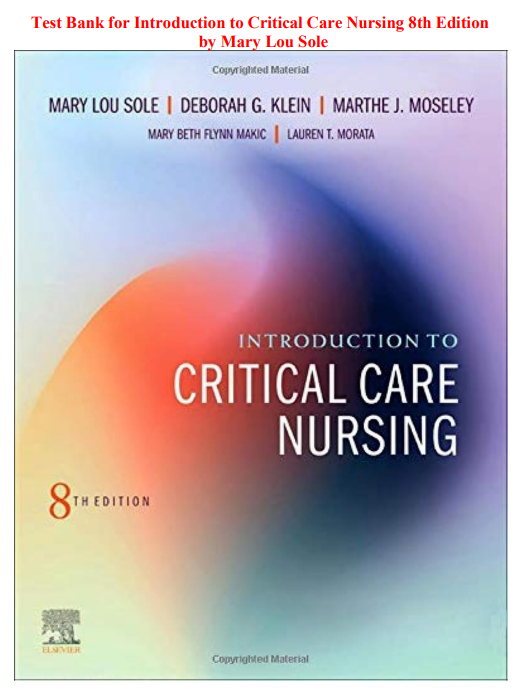
This test bank was built to develop exactly that kind of thinking. It follows Introduction to Critical Care Nursing, 8th Edition by Mary Lou Sole, Deborah Goldenberg Klein, and Marthe J. Moseley — one of the most trusted critical care nursing textbooks used in undergraduate and graduate nursing programs. Every question is designed to push you beyond recall and into the territory of clinical analysis, priority setting, and rapid decision-making that defines critical care practice.
Whether you are preparing for a critical care nursing course exam, studying for the NCLEX-RN, or working toward a CCRN certification, this test bank gives you the focused, high-stakes practice you need.
What Is Inside
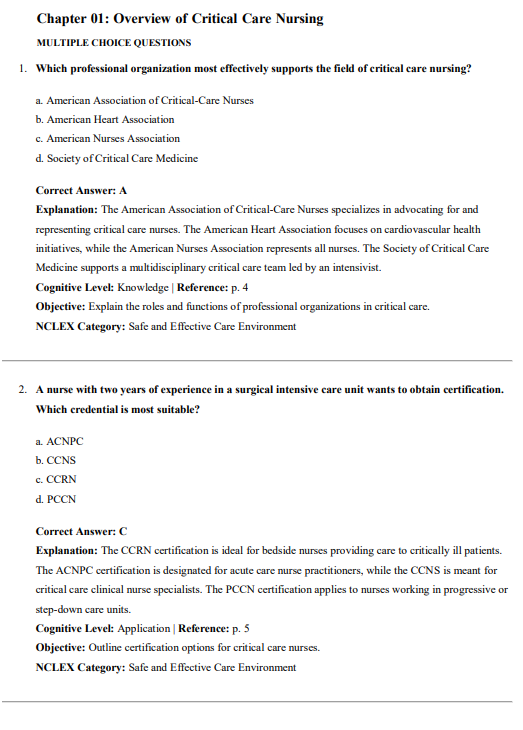
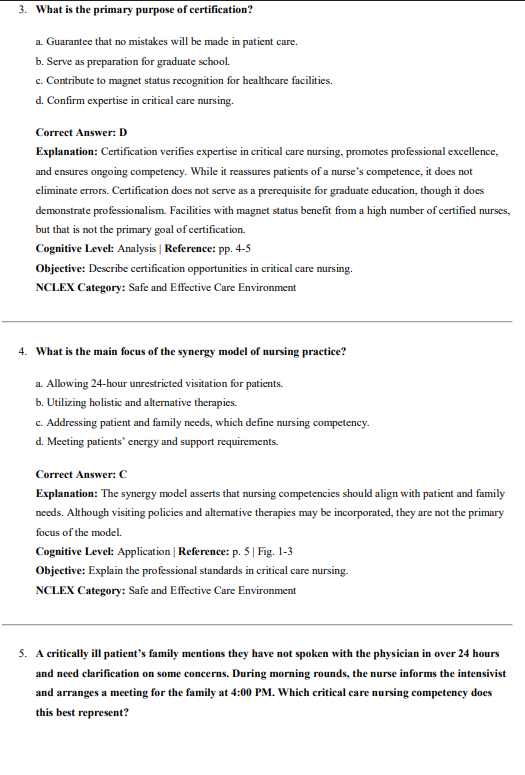
You get over a thousand practice questions covering every major system, condition, and intervention in Sole’s 8th edition. Questions are written in multiple-choice, select-all-that-apply, and ordered response formats — consistent with what you will face on nursing school exams, the NCLEX-RN, and the CCRN certification examination.
Every question has a clearly marked correct answer. Every answer comes with a full written rationale. The rationale does not simply confirm the right choice. It walks you through the pathophysiology, the hemodynamic reasoning, the monitoring parameters, and the clinical priorities that make the correct answer correct — and explains precisely why the other options fall short. In critical care, that depth of understanding is not optional. It is what keeps patients alive.
Topics Covered
The test bank follows the complete structure of Sole’s 8th edition across every major critical care content area, including:
Foundations of Critical Care Nursing — the critical care environment and nursing role, ethical and legal issues in critical care, palliative and end-of-life care in the ICU, family-centered critical care, pain and sedation management, delirium assessment and prevention, and nutritional support for critically ill patients
Hemodynamic Monitoring — arterial line setup and interpretation, central venous pressure monitoring, pulmonary artery catheter use and waveform interpretation, cardiac output measurement, mixed venous oxygen saturation, and troubleshooting hemodynamic monitoring equipment
Cardiovascular Critical Care — acute coronary syndromes including STEMI and NSTEMI, acute heart failure and cardiogenic shock, hypertensive crisis, cardiac dysrhythmia recognition and management, temporary pacemaker management, cardiac tamponade, and post-cardiac surgery care
Pulmonary Critical Care — acute respiratory failure, acute respiratory distress syndrome, mechanical ventilation modes and settings, ventilator weaning and extubation, pneumothorax management, pulmonary hypertension, and care of the patient with a tracheostomy in the ICU
Neurological Critical Care — traumatic brain injury and intracranial pressure monitoring, ischemic and hemorrhagic stroke in the ICU, status epilepticus, Guillain-Barré syndrome, myasthenia gravis crisis, spinal cord injury management, and post-neurosurgical care
Shock and Multisystem Failure — hypovolemic, distributive, cardiogenic, and obstructive shock, sepsis and septic shock including current Surviving Sepsis Campaign guidelines, systemic inflammatory response syndrome, multiple organ dysfunction syndrome, and disseminated intravascular coagulation
Renal Critical Care — acute kidney injury in the ICU, continuous renal replacement therapy, electrolyte emergencies including hyperkalemia and hyponatremia, rhabdomyolysis, and fluid resuscitation principles
Gastrointestinal Critical Care — acute gastrointestinal hemorrhage, acute liver failure, acute pancreatitis in the ICU, abdominal compartment syndrome, stress ulcer prophylaxis, and enteral and parenteral nutrition in critical illness
Endocrine Critical Care — diabetic ketoacidosis, hyperosmolar hyperglycemic state, stress hyperglycemia and insulin protocols, thyroid storm, myxedema coma, and adrenal crisis in critical illness
Hematologic and Immunologic Critical Care — massive transfusion protocols, transfusion reactions, immune thrombocytopenia, neutropenic precautions, and care of immunocompromised patients in the ICU
Trauma and Burns — initial trauma assessment and resuscitation, traumatic injury by system including thoracic, abdominal, and orthopedic trauma, burn assessment and fluid resuscitation using the Parkland formula, inhalation injury, and infection management in burn patients
Toxicology and Drug Overdose — general principles of toxicology management in the ICU, overdose presentations and antidotes, alcohol withdrawal in the critical care setting, and care of patients following poisoning or intentional ingestion
Who Should Use This
This test bank is the right resource for nursing students enrolled in a critical care or intensive care nursing course whose program uses Sole’s 8th edition, NCLEX-RN candidates who want to strengthen their performance on complex priority and management of care questions drawn from critical care content, registered nurses preparing for the CCRN certification examination who need high-quality question-based practice across all major ICU content areas, new graduate nurses transitioning into critical care or step-down units who want to build their clinical reasoning skills before entering the ICU environment, and nursing instructors teaching critical care nursing who need a rigorous, clinically accurate question pool for building course exams, case-based assessments, and simulation debriefs.
Why the 8th Edition Specifically
Critical care medicine moves faster than almost any other field in healthcare. Sepsis management protocols are revised. Ventilator strategies evolve. Hemodynamic monitoring approaches change. The 8th edition of Sole’s textbook incorporates the latest evidence-based guidelines across every major critical care content area — including updated Surviving Sepsis Campaign guidelines, current ARDS Network ventilation strategies, revised pain and sedation protocols based on the PADIS guidelines, and expanded coverage of the ICU liberation bundle.
This test bank was written to align with the 8th edition specifically. The clinical scenarios, monitoring parameters, pharmacologic interventions, and nursing management approaches in the questions reflect what is in this edition. If your course or certification preparation uses the 8th edition, this is the test bank that fits it directly.
5 Sample Questions
Question 1 A nurse is caring for a patient in the ICU following a massive anterior myocardial infarction. The patient’s blood pressure is 78/50 mmHg, heart rate is 118 beats per minute, urine output has been 12 mL over the last hour, and the patient is cool and clammy. The pulmonary artery catheter shows a cardiac index of 1.6 L/min/m² and a pulmonary artery wedge pressure of 24 mmHg. How should the nurse interpret these findings?
A. Hypovolemic shock — the patient needs aggressive fluid resuscitation B. Cardiogenic shock — the heart is failing to pump effectively despite adequate filling pressures C. Distributive shock — vasodilation is causing hypotension despite normal cardiac function D. Obstructive shock — an external pressure is preventing adequate cardiac output
Correct Answer: B The clinical picture is consistent with cardiogenic shock. The cardiac index below 2.2 L/min/m² indicates severely reduced cardiac output. The elevated pulmonary artery wedge pressure of 24 mmHg shows the ventricles are full — this is not a volume problem. The hypotension, tachycardia, oliguria, and cool clammy skin reflect inadequate tissue perfusion from pump failure. Fluid resuscitation would worsen pulmonary congestion. Management focuses on inotropic support, vasopressors if needed, and potentially mechanical circulatory support.
Question 2 A mechanically ventilated patient in the ICU has the following arterial blood gas results: pH 7.22, PaCO₂ 58 mmHg, PaO₂ 88 mmHg, HCO₃ 23 mEq/L, SpO₂ 95%. How should the nurse interpret this result and what is the priority action?
A. Metabolic acidosis — administer sodium bicarbonate as ordered B. Respiratory acidosis — notify the provider and anticipate ventilator setting adjustments C. Compensated respiratory alkalosis — continue current ventilator settings and monitor D. Mixed acid-base disorder — obtain a repeat ABG in four hours before taking action
Correct Answer: B The pH of 7.22 confirms acidosis. The elevated PaCO₂ of 58 mmHg identifies the cause as respiratory — carbon dioxide is accumulating because ventilation is inadequate. The near-normal bicarbonate indicates no metabolic compensation has occurred, meaning this is an acute process. In a mechanically ventilated patient, respiratory acidosis is addressed by adjusting ventilator settings — typically increasing the respiratory rate or tidal volume to improve CO₂ elimination. This requires immediate provider notification and anticipatory preparation for ventilator changes.
Question 3 A patient admitted to the ICU with septic shock has been started on norepinephrine. Despite the vasopressor, the mean arterial pressure remains at 58 mmHg. The patient has received 30 mL/kg of IV crystalloid. Lactate is 4.8 mmol/L and trending upward. Which intervention should the nurse anticipate next?
A. Administer an additional 2 L fluid bolus to maximize preload B. Prepare to add vasopressin or increase norepinephrine dose per protocol C. Discontinue norepinephrine and switch to dopamine D. Initiate cooling measures to address the underlying infection
Correct Answer: B According to the Surviving Sepsis Campaign guidelines, when a patient with septic shock fails to achieve a MAP of 65 mmHg despite adequate fluid resuscitation and initial vasopressor support, a second vasopressor should be added — vasopressin is commonly added to norepinephrine in this scenario. The patient has already received the recommended fluid resuscitation volume. A rising lactate indicates worsening tissue hypoperfusion and the urgency of achieving hemodynamic targets. Dopamine is no longer a first-line vasopressor in septic shock due to its adverse dysrhythmia profile.
Question 4 A nurse is caring for a patient with a traumatic brain injury and an intracranial pressure of 26 mmHg. The cerebral perfusion pressure is calculated at 54 mmHg. The patient is on mechanical ventilation. Which nursing intervention is the priority?
A. Hyperventilate the patient to a PaCO₂ of 25 mmHg to rapidly reduce ICP B. Position the head of the bed flat to maximize cerebral blood flow C. Notify the provider, minimize stimulation, and prepare to administer hyperosmolar therapy D. Administer a 500 mL normal saline bolus to increase mean arterial pressure
Correct Answer: C An ICP above 20 to 22 mmHg is abnormal and a CPP below 60 mmHg indicates inadequate cerebral perfusion. The nurse must notify the provider immediately, minimize any stimulation that could further elevate ICP, and anticipate administration of hyperosmolar therapy such as mannitol or hypertonic saline to reduce cerebral edema. Prolonged aggressive hyperventilation causing PaCO₂ of 25 mmHg causes cerebral vasoconstriction that can worsen ischemia and is not recommended as sustained therapy. The head of the bed should be elevated 30 degrees, not flat.
Question 5 A nurse is assessing a patient in the ICU who developed acute kidney injury following cardiac surgery. The patient’s potassium level has risen to 6.8 mEq/L. The cardiac monitor shows peaked T waves and a widening QRS complex. What is the nurse’s immediate priority action?
A. Administer sodium polystyrene sulfonate rectally to bind potassium in the gut B. Restrict dietary potassium and recheck the level in six hours C. Notify the provider and prepare calcium gluconate for immediate administration D. Prepare the patient for emergent hemodialysis
Correct Answer: C Peaked T waves and widening QRS complex are life-threatening electrocardiographic signs of severe hyperkalemia affecting cardiac conduction. The immediate priority is cardiac membrane stabilization, which is achieved with calcium gluconate. Calcium does not lower the potassium level but it protects the heart from dysrhythmia while other measures work to reduce potassium. After stabilizing the myocardium, the team will use insulin with dextrose, sodium bicarbonate, or albuterol to shift potassium into cells, and then initiate definitive removal through kayexalate, diuresis, or dialysis. Waiting six hours in this situation is dangerous.
Frequently Asked Questions
Is this the official Elsevier test bank for Sole’s textbook? No. This is an independently developed study resource based on the content of Sole, Klein, and Moseley’s 8th edition. It is not published or endorsed by Elsevier or the original authors. It is a supplementary exam preparation tool for nursing students, NCLEX candidates, and nurses preparing for CCRN certification.
How many questions are in the test bank? There are over a thousand questions in total. They are distributed across all major critical care content areas in the 8th edition, with more questions in the highest-volume topics including cardiovascular critical care, respiratory management, shock, and sepsis.
Can I use this test bank to study for the CCRN certification examination? Yes. The content covered in Sole’s 8th edition maps closely to the CCRN blueprint, and the questions in this test bank are written at the application and analysis levels that the CCRN demands. It is a strong supplementary resource for certification preparation, particularly for the clinical content sections of the exam.
Critical care is overwhelming. Where should I start? Start with the foundational chapters — hemodynamic monitoring, ventilator management, and shock. These concepts appear in almost every other critical care topic. Once you understand how to read a hemodynamic profile, interpret an ABG, and recognize early shock, the rest of the content becomes significantly easier to organize and apply.
Is this test bank suitable for new nurses transitioning into the ICU? Yes. New ICU nurses often describe their first months as a steep learning curve. Using this test bank alongside orientation and preceptorship helps bridge the gap between textbook knowledge and clinical application. Working through scenarios systematically across body systems builds pattern recognition that develops faster with deliberate question-based practice than with clinical exposure alone.
Does every question include a rationale? Yes, without exception. Every question has a correct answer and a full written rationale that explains the pathophysiology, hemodynamic reasoning, and clinical priorities behind it. In critical care, understanding why an answer is correct — not just that it is — is what separates safe practice from guesswork.
Can nursing instructors use this to build critical care course exams? Yes. Questions are organized by system and topic, making it easy to build unit exams, case-based assessments, or simulation preparation materials. The questions are written at the level of complexity appropriate for advanced undergraduate and graduate critical care nursing courses.
What file format is the test bank delivered in? It is delivered as a digital file, typically in Word or PDF format. You can search by system, condition, or keyword, print specific chapters for focused study sessions, or access it across multiple devices. Many students and nurses use it to run timed practice sessions that simulate the time pressure of both the NCLEX-RN and the CCRN examination.
Is this test bank specific to the 8th edition only? Yes. It was written to align with the clinical guidelines, evidence-based protocols, and content organization of the 8th edition. Critical care guidelines — including sepsis management, ventilation strategies, and sedation protocols — are updated frequently, and earlier editions may not reflect current practice standards. Always confirm your edition before purchasing.

Grace W. –
Exactly what I needed
Dorcas M. –
Excellent
Gerald N –
A perfect study guide
Caleb Martins c –
Very very good
Carol Kay –
much better than I expected
Bruno Molino –
Solid material for ICU exam preps
Liam Mbogo –
Great
Kevin May –
Great resource for testing my ICU nursing knowledge.
Mary Lincoln –
The explanations are concise and easy to follow.