Healthcare runs on information. Every order, every assessment finding, every medication administration record, every lab result, every care plan — all of it is data. And the nurse at the bedside is not just a consumer of that data. The nurse is one of its most important generators, interpreters, and guardians.
Nursing informatics is the discipline that sits at the intersection of nursing science, information science, and computer science. It is what allows the clinical knowledge nurses generate every shift to be captured, organized, analyzed, and used — to improve care for the next patient, to identify system-wide safety problems, to support evidence-based practice, and to build the learning healthcare system that modern nursing demands.
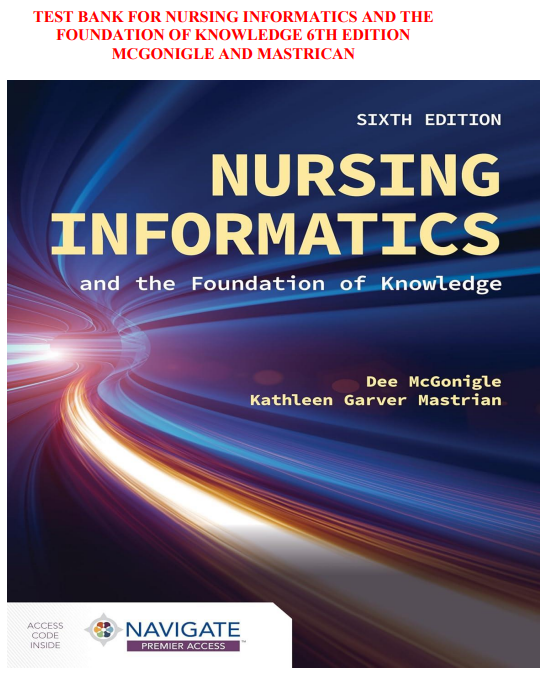
Most nursing students encounter informatics as an afterthought — a chapter on electronic health records tucked into a fundamentals textbook. McGonigle and Mastrian’s Nursing Informatics and the Foundation of Knowledge treats it as exactly what it is: a foundational nursing discipline with its own theory, its own body of knowledge, its own research base, and its own set of competencies that every nurse — from the bedside LPN to the chief nursing informatics officer — needs to develop.
The 6th edition continues that tradition with updated content on artificial intelligence in healthcare, expanded coverage of data science and analytics in nursing, revised cybersecurity and privacy content, stronger integration of interoperability standards, and deeper engagement with the ethical dimensions of health information technology.
This test bank was built to match it. Every question pushes you to think about information not as background noise in clinical practice but as a clinical tool — one that, used well, improves patient outcomes, and used poorly, introduces risk.
What Is Inside
You get over a thousand practice questions covering every major theoretical framework, clinical application domain, and emerging technology area in McGonigle and Mastrian’s 6th edition. Questions are written in multiple-choice, select-all-that-apply, and ordered response formats — consistent with what you will encounter on nursing informatics course exams and advanced practice certification examinations.
Every question has a clearly marked correct answer. Every answer includes a full written rationale. The rationale explains the informatics concept, theoretical framework, or evidence-based standard behind the correct choice and addresses specifically why each wrong option reflects a misunderstanding of nursing informatics principles or an inappropriate application of health information technology. In a discipline where the stakes of getting it wrong include patient safety, privacy violations, and system failures, that depth of explanation is essential.
Topics Covered
The test bank follows the complete structure of the 6th edition across every major content domain, including:
Foundations of Nursing Informatics — definition and scope of nursing informatics as a specialty, the evolution of nursing informatics from data management to knowledge generation, the American Nurses Association’s Scope and Standards of Nursing Informatics Practice, the role of the nursing informatics specialist, informatics competencies for nurses at every level of practice from bedside nurse to advanced practice to nursing informaticist, and the intersection of nursing science, information science, and computer science in informatics practice
The Foundation of Knowledge Model — McGonigle and Mastrian’s Foundation of Knowledge Model as a conceptual framework for nursing informatics, knowledge acquisition and how nurses gather information in clinical practice, knowledge processing and critical analysis of data, knowledge generation through nursing research and evidence-based practice, knowledge dissemination and the translation of knowledge into clinical systems and practice change, and feedback loops within the knowledge foundation
Data, Information, Knowledge, and Wisdom — the DIKW hierarchy and its application to nursing practice, distinguishing raw data from meaningful information, transforming information into actionable clinical knowledge, the role of wisdom in applying knowledge to individual patient situations, and the nurse’s role in each level of the DIKW continuum in clinical and systems contexts
Healthcare Information Systems — types of clinical information systems including electronic health records, clinical decision support systems, nursing documentation systems, pharmacy information systems, laboratory information systems, and radiology information systems, the history and evolution of health information technology in the United States, meaningful use and the HITECH Act, health information exchanges and interoperability, and the role of the nurse in system selection, implementation, and evaluation
Electronic Health Records — components and functions of the EHR, nursing documentation in the EHR including nursing assessments, care plans, and nursing notes, structured versus unstructured data in nursing documentation, the impact of EHR design on nursing workflow, clinical documentation burden and strategies to address it, nursing role in EHR implementation and optimization, and quality of care implications of EHR documentation practices
Clinical Decision Support Systems — types and functions of clinical decision support including alerts, reminders, order sets, and clinical pathways, evidence-based foundations of clinical decision support, alert fatigue and its impact on patient safety, the nurse’s role in evaluating and responding to clinical decision support, and the development and maintenance of evidence-based order sets and protocols
Telehealth and Remote Patient Monitoring — telehealth modalities including synchronous and asynchronous care delivery, remote patient monitoring technologies and their clinical applications, nursing practice in telehealth environments, scope of practice and licensure considerations in telehealth nursing, patient education for telehealth use, digital divide and equity considerations in telehealth, and the evidence base for telehealth outcomes in nursing-sensitive conditions
Health Informatics Standards and Interoperability — the importance of data standards in health information exchange, nursing-specific terminologies including NANDA-I, NIC, NOC, the Omaha System, and SNOMED CT, HL7 and FHIR interoperability standards, clinical documentation improvement and standardized nursing language, the impact of interoperability on care coordination and continuity, and the nurse’s role in promoting standardized language in clinical practice
Privacy, Confidentiality, and Security in Health Information — HIPAA and its implications for nursing practice, the Privacy Rule and Security Rule in clinical contexts, patient rights regarding health information, breach notification requirements and nursing responsibilities, role-based access control and its application to nursing practice, social media and nursing confidentiality obligations, and the nurse’s role in building a culture of information privacy and security
Cybersecurity in Healthcare — types of cybersecurity threats in healthcare settings including ransomware, phishing, and insider threats, the clinical impact of cybersecurity incidents on patient safety, nursing responsibilities in cybersecurity including password hygiene, device security, and suspicious activity reporting, organizational cybersecurity frameworks and the nurse’s role within them, and emerging cybersecurity challenges in connected medical devices and IoT in healthcare
Artificial Intelligence and Machine Learning in Nursing — foundational concepts of artificial intelligence and machine learning relevant to nursing, AI applications in clinical practice including predictive analytics, early warning systems, and diagnostic support, natural language processing and its use in nursing documentation analysis, ethical considerations in AI-assisted nursing practice, bias in AI systems and implications for health equity, and the nurse’s evolving role in AI governance and oversight
Data Science and Analytics in Nursing — types of healthcare analytics including descriptive, predictive, and prescriptive analytics, nursing-sensitive quality indicators and their measurement, population health management and data-driven nursing practice, clinical registries and their use in nursing quality improvement, data visualization and its application in nursing administration and quality, and the nurse’s role in translating data analytics findings into practice change
Informatics in Nursing Education — technology-enhanced learning environments, learning management systems and their use in nursing education, simulation technology and its informatics dimensions, distance education and online learning in nursing, the use of social media and web 2.0 tools in nursing education, information literacy and lifelong learning in the digital age, and preparing nursing students for informatics-competent practice
Nursing Research and Evidence-Based Practice in Informatics — the role of informatics in supporting the nursing research process, electronic databases and literature search strategies for evidence-based practice, systematic review and meta-analysis in nursing informatics research, translating research findings into clinical information systems, the learning health system model and its nursing implications, and emerging research methods in nursing informatics including big data research and data mining
Leadership and Project Management in Nursing Informatics — the nurse informaticist as change leader, project management principles applied to health IT implementations, systems development life cycle and nursing involvement at each phase, vendor selection and contract negotiation basics for nursing leaders, governance structures for health information technology, and building interprofessional collaboration for informatics projects
Consumer Health Informatics and Patient Engagement — patient portals and their role in patient engagement, personal health records and consumer-generated health data, health apps and wearable technology in patient self-management, digital health literacy and its relationship to health outcomes, nursing’s role in supporting patients’ use of consumer health technology, and equity considerations in consumer health informatics
Global Health Informatics — international health informatics initiatives and standards, global interoperability challenges and nursing implications, health informatics in resource-limited settings, the World Health Organization’s digital health strategy, and the nurse’s role in global health information systems development and implementation
Who Should Use This
This test bank is the right resource for undergraduate and graduate nursing students enrolled in nursing informatics courses whose programs use McGonigle and Mastrian’s 6th edition, nursing informatics specialists pursuing or maintaining ANCC certification in nursing informatics who need comprehensive content-area question practice, advanced practice nursing students who need to develop informatics competency alongside their clinical preparation, nursing faculty teaching informatics or health information technology courses who need a theoretically grounded and clinically relevant question pool for building assessments, nurse leaders and administrators involved in EHR implementation, clinical decision support development, or health IT governance who want to deepen their informatics knowledge base, and students and nurses in programs emphasizing population health, quality improvement, or data-driven nursing practice who need to understand the informatics infrastructure that supports those disciplines.
Why the 6th Edition Specifically
Health information technology evolves faster than almost any other domain in nursing education. Artificial intelligence is moving from research settings into clinical workflows. Cybersecurity threats are intensifying. Interoperability standards are being updated and mandated. Telehealth has permanently expanded as a care delivery modality. The ethical dimensions of algorithmic decision-making in healthcare are receiving increasing scrutiny.
The 6th edition of McGonigle and Mastrian reflects all of these developments — with new and expanded content on AI and machine learning in nursing, updated cybersecurity frameworks, revised HIPAA and privacy content, strengthened coverage of FHIR and interoperability standards, expanded data science and analytics content, and deeper engagement with equity in health information technology.
This test bank was written to align with the 6th edition specifically. The theoretical frameworks, technology applications, regulatory standards, and ethical frameworks in the questions reflect what is in this edition. If your course uses the 6th edition, this is the resource that fits it directly.
5 Sample Questions
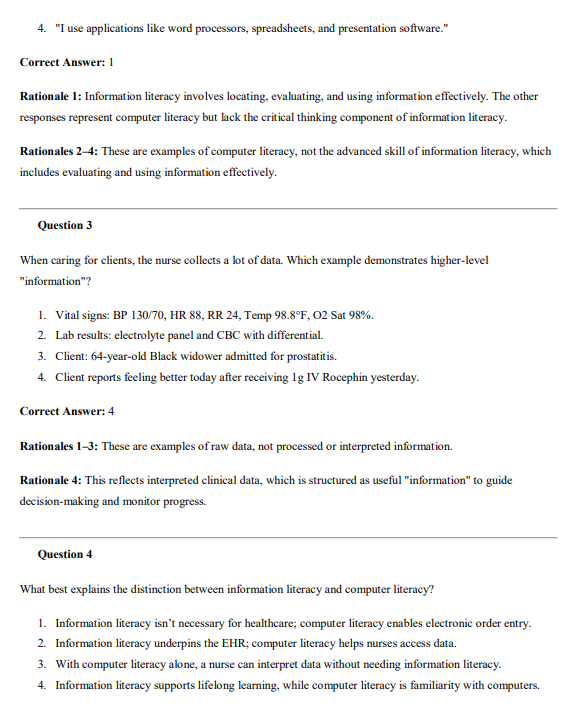
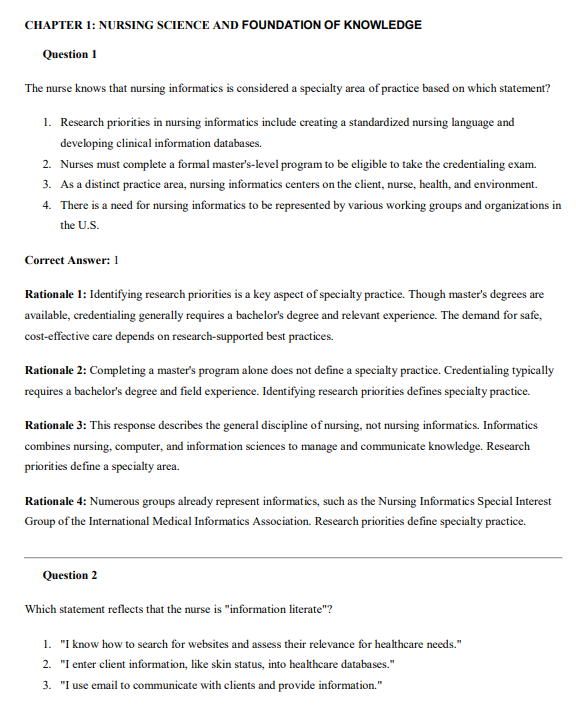
Question 1 A nursing informaticist is reviewing a hospital’s clinical decision support system and discovers that nurses are overriding medication allergy alerts at a rate of 87%. The informaticist presents this finding to the nursing informatics governance committee. Using informatics principles, which explanation best accounts for this pattern and which intervention is most appropriate?
A. Nurses are disregarding patient safety — mandatory retraining on allergy documentation protocols should be implemented immediately B. Alert fatigue from excessive, low-specificity alerts is causing nurses to override warnings habitually — the alert system should be reviewed and refined to improve specificity and reduce non-actionable alerts C. The EHR allergy documentation module is malfunctioning and should be taken offline pending a vendor patch D. Override rates above 80% are within acceptable parameters for clinical decision support systems and require no intervention
Correct Answer: B Alert fatigue is a well-documented patient safety phenomenon in which clinicians become desensitized to clinical decision support alerts due to high volume and low clinical relevance. When the majority of alerts are non-actionable — triggering for minor interactions, theoretical allergies, or already-addressed clinical situations — nurses learn to override them automatically, including potentially critical alerts that warrant attention. The appropriate informatics intervention is to analyze override patterns, classify alert types by clinical significance, suppress or restructure low-value alerts, and preserve high-specificity alerts that require action. Mandatory retraining does not address the underlying system design problem. An 87% override rate is not acceptable and represents a significant patient safety risk.
Question 2 A nurse working on a medical unit receives a text message from someone identifying themselves as the hospital’s IT department, asking the nurse to click a link and verify their login credentials due to a system upgrade. Which action best reflects nursing cybersecurity competency?
A. Click the link and enter credentials since the request appears to come from the IT department B. Forward the message to colleagues to warn them about the system upgrade C. Delete the message, do not click the link, and report it to the IT security team as a suspected phishing attempt D. Reply to the message asking for the IT employee’s name before deciding whether to comply
Correct Answer: C This scenario describes a classic phishing attack — a social engineering technique in which malicious actors impersonate trusted entities to obtain login credentials. Legitimate IT departments do not request passwords or login credentials via text message or email links. The nurse should immediately delete the message without clicking the link and report it to the IT security team so the threat can be investigated and other staff alerted. Forwarding the message spreads potential malware exposure. Replying to the message engages with the attacker and may provide information used to refine the attack. Healthcare organizations are among the most frequently targeted sectors for phishing attacks due to the value of health information on the dark web.
Question 3 A nurse is documenting a patient assessment in the electronic health record using structured data fields. The nurse notes that the patient has described their pain using culturally specific language and metaphors that do not fit neatly into the standardized pain scale fields. Which action best reflects informatics-competent nursing practice?
A. Select the closest numerical pain rating and leave it at that since structured fields are all the EHR captures B. Skip the pain documentation entirely and address it verbally during handoff report C. Complete the structured fields with the best available rating and use a free-text narrative field to capture the patient’s own description and cultural context of their pain experience D. Override the structured documentation requirement by writing only in free-text fields to preserve the richness of the patient’s account
Correct Answer: C Structured data fields are essential for standardization, quality measurement, and interoperability — but they cannot always capture the full clinical picture. Informatics-competent nursing practice involves using structured fields to ensure data comparability and analytics capability while supplementing them with free-text narrative documentation to preserve clinical nuance, patient voice, and culturally relevant information. This approach honors both the informatics imperatives of standardized data capture and the nursing imperative of holistic, patient-centered documentation. Skipping documentation creates a legal and clinical gap. Using only free-text eliminates the data from quality measurement systems. A balanced approach is the most professionally defensible practice.
Question 4 A hospital is implementing a predictive analytics tool that uses machine learning to identify patients at high risk for sepsis. The nursing informatics team is reviewing the model’s performance data and discovers that the algorithm was trained on a dataset that significantly underrepresented patients of color, resulting in lower sensitivity for sepsis prediction in Black and Hispanic patients compared to white patients. Which response best reflects ethical nursing informatics practice?
A. Accept the tool as-is since any predictive capability is better than none and the disparity will likely self-correct over time as more data is collected B. Implement the tool only in units serving predominantly white patient populations where accuracy is highest C. Escalate the finding to leadership, advocate for pausing implementation until the model is retrained on a representative dataset or alternative bias mitigation strategies are applied, and document the equity concern formally D. Add a disclaimer in the EHR noting that the algorithm may be less accurate for some patient populations and proceed with full implementation
Correct Answer: C Algorithmic bias in clinical decision support is a patient safety and health equity issue of the highest order. A sepsis prediction tool that performs less accurately for patients of color perpetuates and potentially amplifies existing healthcare disparities — delaying life-saving interventions for already-vulnerable populations. Ethical nursing informatics practice requires the nurse informaticist to identify bias, escalate the concern through appropriate governance channels, advocate for corrective action before implementation, and formally document the concern regardless of what decision leadership ultimately makes. Accepting the tool, restricting it to certain populations, or adding a disclaimer without meaningful remediation are all ethically insufficient responses.
Question 5 A hospital system is preparing to transition from one electronic health record platform to another. The nursing informatics specialist is asked to represent nursing during the system selection process. Which contribution by the nursing informatics specialist most directly reflects the nursing profession’s informatics advocacy role?
A. Defer all technical decisions to the IT department since nurses lack the technical expertise to evaluate EHR platforms B. Review vendor marketing materials and select the platform with the most modern visual interface C. Facilitate structured nursing workflow assessments, identify nursing documentation requirements, evaluate how each platform supports nursing-sensitive quality indicator capture, and present nursing’s evidence-based requirements to the selection committee D. Advocate for the platform that requires the least change to current nursing documentation practices to minimize staff resistance
Correct Answer: C The nursing informatics specialist serves as the bridge between the clinical needs of nursing staff and the technical capabilities of health information systems. During system selection, this means conducting rigorous workflow analysis, identifying what nursing documentation the system must support, evaluating how each platform captures nursing-sensitive quality data, and bringing an evidence-based, patient-centered nursing perspective to a process that might otherwise be dominated by financial and technical considerations alone. Deferring to IT abandons nursing’s advocacy role. Selecting based on aesthetics ignores clinical functionality. Choosing the path of least resistance prioritizes change management convenience over patient care quality.
Frequently Asked Questions
Is this the official Jones & Bartlett Learning test bank for McGonigle and Mastrian’s 6th edition? No. This is an independently developed study resource based on the content of McGonigle and Mastrian’s 6th edition. It is not published or endorsed by Jones & Bartlett Learning or the original authors. It is a supplementary exam preparation and professional development tool for nursing students and faculty.
How many questions are in the test bank? There are over a thousand questions distributed across all major informatics content domains in the 6th edition, with strong representation in the highest-yield areas including the Foundation of Knowledge Model, EHR documentation and clinical decision support, privacy and security, AI and data analytics, and nursing informatics leadership.
I do not have a strong technology background. Is this test bank too technical for me? No. McGonigle and Mastrian’s textbook is deliberately written to be accessible to nurses at all levels of technology comfort, and this test bank reflects that approach. The questions focus on the nursing implications of informatics concepts — not technical programming or systems architecture. You do not need a computer science background to succeed with this content. You need to understand how information systems affect nursing practice, patient safety, and healthcare quality.
Is nursing informatics tested on the NCLEX-RN? Yes, indirectly but importantly. The NCLEX-RN includes management of care and safety and infection control content that encompasses informatics-related competencies — including documentation accuracy, use of clinical decision support, privacy and confidentiality, and safe medication administration using technology. Students with strong informatics knowledge consistently perform better on these question types.
Can this test bank help me prepare for the ANCC Nursing Informatics certification examination? Yes. The content in McGonigle and Mastrian’s 6th edition maps closely to the ANCC Nursing Informatics certification blueprint, and questions in this test bank are written at the application and analysis levels the certification examination demands. It works well as a supplementary resource alongside a dedicated certification review program.
Does every question include a rationale? Yes, without exception. Every question has a correct answer and a full written rationale that explains the informatics principle, theoretical framework, or regulatory standard behind the correct choice and addresses why each wrong option reflects a misapplication or misunderstanding of nursing informatics concepts. In a discipline where the consequences of poor informatics decisions include privacy breaches, patient safety events, and system failures, understanding the reasoning behind every answer is essential.
Can nursing faculty use this to build informatics course assessments? Yes. Questions are organized by chapter and content domain, making it straightforward to build unit quizzes, case-based assessments, or comprehensive final examinations that test both theoretical literacy and applied informatics competency. The questions span foundational knowledge recall through complex scenario-based analysis, giving instructors flexibility to build assessments appropriate for undergraduate and graduate informatics courses.
What file format is the test bank delivered in? It comes as a digital file, typically in Word or PDF format. You can search by topic, technology domain, or regulatory framework, print specific chapters for focused study sessions, and access it across multiple devices.
Is this test bank specific to the 6th edition only? Yes. It was written to align with the theoretical frameworks, technology content, regulatory standards, and emerging topics in the 6th edition — including its new AI and machine learning content, updated cybersecurity frameworks, and revised interoperability standards. Earlier editions do not reflect these developments. Always confirm your course edition before purchasing.



Lucille Maria –
A perfect test bank. It is exactly what I was looking for
Winnie M. –
I like the fact that is it searchable, meaning I can easily find what I need when I need it
Caleb Martins –
Perfectly organized
Carol Kay –
Very good. Helped me build confidence to face my finals
Bruno Molino –
Delivered exactly what I paid for. Thanks.
Mary Kesh –
Excellent study resource
Janny Cummings –
Very good relevant practice questions
Liam Mbogo –
Highly valuable study material.
Beverly –
worth adding to your study routine
Lucas Gabriel –
Helpful practice material for nursing students
Lisa Horton –
I like it a lot
Melania Angel –
I really needed it to build exam confidence