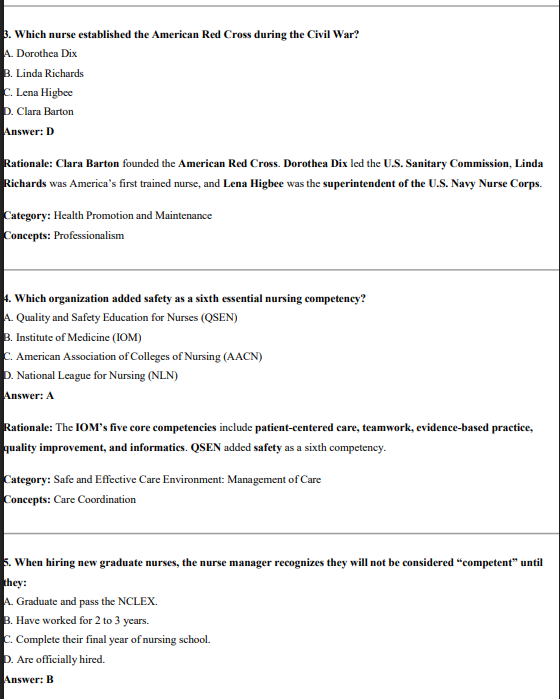
Build a Strong Foundation in Nursing with Active Learning
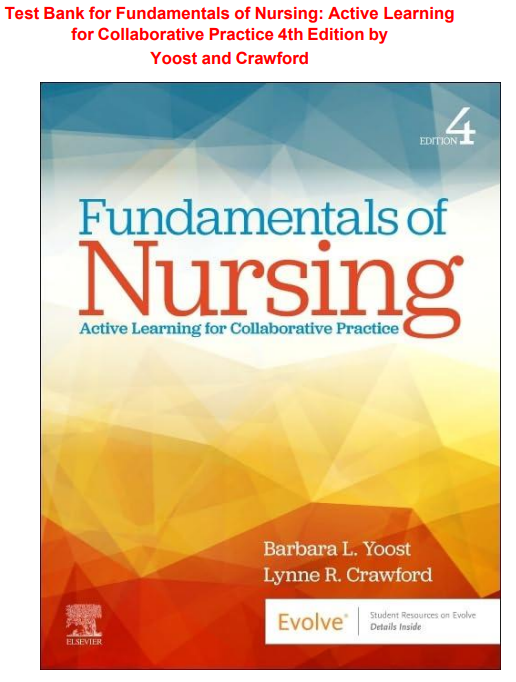
Starting nursing school can feel overwhelming. You have to learn clinical skills, safety procedures, and ethical guidelines all at once. The Test Bank for Fundamentals of Nursing: Active Learning for Collaborative Practice (4th Edition) by Yoost and Crawford makes studying simple, clear, and effective.
This test bank helps you move past basic memorization. It focuses on practical application, collaborative teamwork, and clinical judgment.
Whether you are studying for unit exams or preparing early for the Next-Generation NCLEX (NGN), these practice questions give you the confidence you need to excel in class and clinical practice.
Why Nursing Students Choose This Test Bank
1. Focuses on Collaborative Practice and Safety
Modern nursing requires strong communication and teamwork. This test bank emphasizes patient-centered care, safety protocols, and interprofessional collaboration. You learn how to make safe choices in real clinical settings.
2. Aligned with Next-Gen NCLEX (NGN) Formats
The 4th edition updates align directly with NGN standards. Questions test your ability to recognize cues, analyze patient data, prioritize actions, and evaluate outcomes.
3. Clear Explanations for Every Answer
Learning happens when you understand your mistakes. Each question comes with a detailed rationale for both correct and incorrect options. This helps you build solid clinical reasoning.
Key Features
- Complete Chapter Coverage: Covers all key fundamentals topics, including infection control, dosage calculation concepts, patient safety, and physical assessment.
- Instant Digital Access: Download your file immediately in PDF format on your computer, tablet, or phone.
- NCLEX-Style Questions: Practice with multiple-choice, select-all-that-apply, and priority delegation questions.
- Simple and Direct Writing: Practice questions use clear language to keep your focus on core nursing concepts.
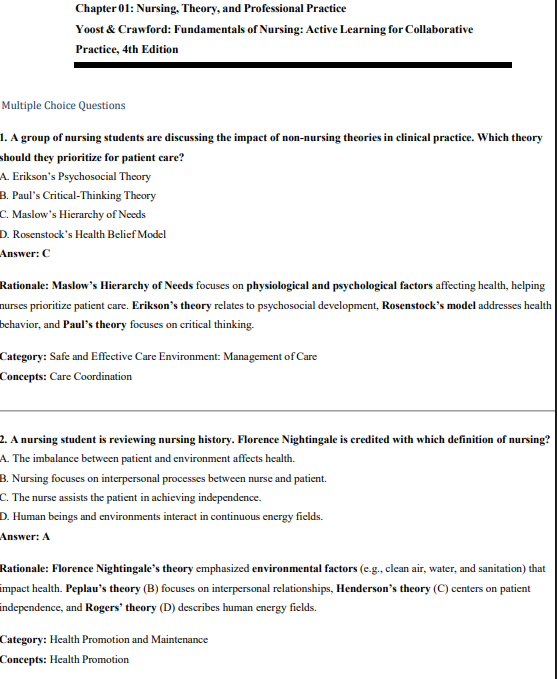
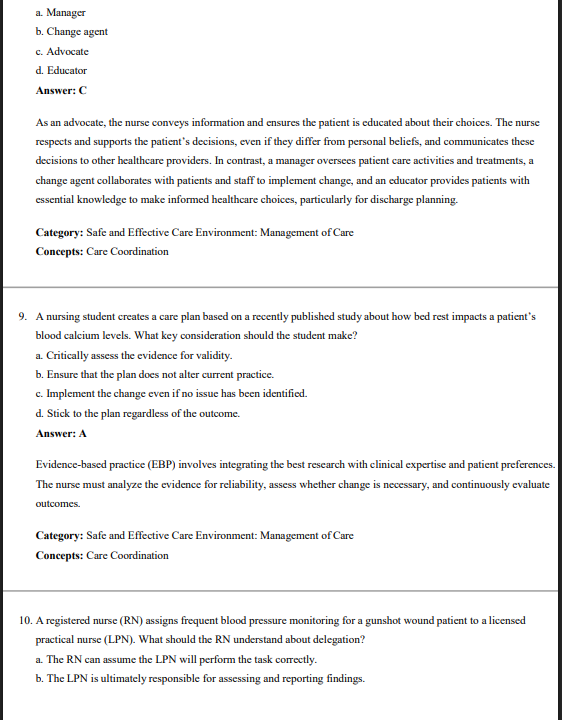
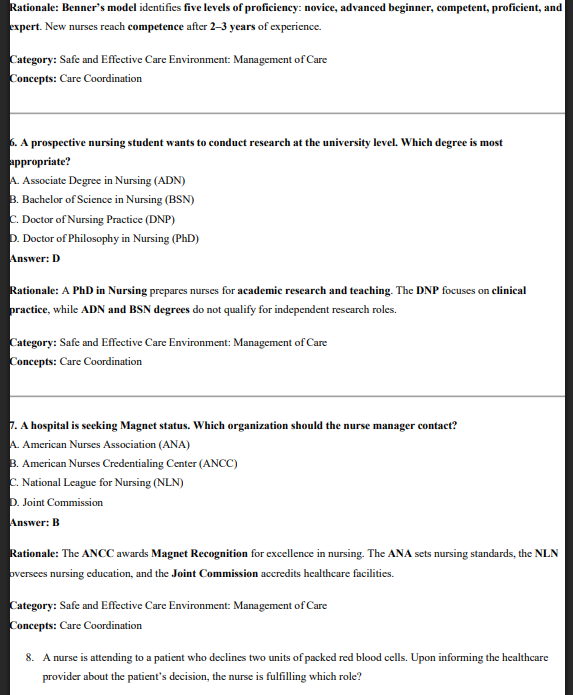
Sample NCLEX-Style Practice Questions
Test your knowledge with these five sample questions from the test bank.
Question 1
Topic: Infection Control & Patient Safety
A nurse is caring for a client placed on Contact Precautions for a Clostridioides difficile (C. diff) infection. Which action by the nurse shows proper infection control practice?
A. Cleaning hands with an alcohol-based hand rub before entering the room.
B. Washing hands with soap and water after removing gloves.
C. Wearing an N95 respirator mask before entering the client’s room.
D. Placing the client in a negative-pressure airflow room.
- Correct Answer: B. Washing hands with soap and water after removing gloves.
- Rationale: C. diff produces bacterial spores that are resistant to alcohol-based hand sanitizers. Physical washing with soap and water is required to remove these spores from hands. Masks and negative-pressure rooms are used for airborne infections, not contact infections.
Question 2
Topic: Nursing Process & Assessment
A nurse collects subject data during an admission assessment. Which statement by the client is an example of subjective data?
A. “My blood pressure reading yesterday was 130/80 mmHg.”
B. “I have a sharp pain in my lower back when I bend down.”
C. The client’s surgical wound site is red and warm to touch.
D. The client’s heart rate is 88 beats per minute.
- Correct Answer: B. “I have a sharp pain in my lower back when I bend down.”
- Rationale: Subjective data consists of feelings, perceptions, or symptoms reported directly by the client. Pain is subjective because only the patient can feel it. Physical exam findings and vital sign measurements are objective data observed by the nurse.
Question 3
Topic: Vital Signs & Clinical Judgment
A nurse measures the vital signs of an adult client at rest. The readings are: Heart rate 112 bpm, Blood pressure 118/76 mmHg, Respiratory rate 16 breaths/min, Temperature 98.6°F (37°C). Which term accurately describes the client’s heart rate?
A. Bradycardia
B. Tachycardia
C. Bradypnea
D. Tachypnea
- Correct Answer: B. Tachycardia
- Rationale: A normal adult resting heart rate ranges between 60 and 100 beats per minute. A heart rate above 100 beats per minute is classified as tachycardia. Bradycardia refers to a slow heart rate (below 60 bpm). Bradypnea and tachypnea refer to breathing rates.
Question 4
Topic: Patient Safety & Mobility
A nurse is helping a weak client ambulate from the bed to a chair. What is the most important safety action the nurse should take before starting the transfer?
A. Put a gait belt around the client’s waist.
B. Ask the client to perform arm raise exercises.
C. Place a pillow on the chair seat.
D. Administer pain medication immediately after moving.
- Correct Answer: A. Put a gait belt around the client’s waist.
- Rationale: Using a gait belt provides a secure point of control for the nurse during transfers. It prevents falls and reduces injury risk for both the client and the nurse. Performing exercises or placing pillows are not primary safety priorities during a transfer.
Question 5
Topic: Ethics & Professional Nursing
A nurse respects a competent adult client’s decision to refuse a recommended blood transfusion. Which ethical principle is the nurse upholding?
A. Beneficence
B. Autonomy
C. Justice
D. Fidelity
- Correct Answer: B. Autonomy
- Rationale: Autonomy is the ethical principle of respecting a patient’s right to self-determination and personal decision-making. As long as the client is competent, they have the legal and ethical right to refuse any medical treatment. Beneficence refers to doing good, and fidelity refers to keeping promises.
Frequently Asked Questions (FAQ)
What format will I receive after buying this test bank?
You will get an instant digital file in PDF format. You can download and save it to any personal device right away.
Does this test bank include answers and rationales?
Yes! Every question comes with the correct answer highlighted along with a short, easy-to-understand rationale.
Does this cover the 4th Edition of Yoost and Crawford?
Yes. The questions, chapters, and concepts match the 4th Edition of Fundamentals of Nursing: Active Learning for Collaborative Practice.
Can I practice these questions on my smartphone?
Yes. The PDF format works on smartphones, tablets, laptops, and desktop computers without extra software.
Is this resource helpful for nursing fundamentals exams?
Absolutely. Practice questions cover foundational concepts, clinical decision-making, and safety protocols frequently tested in fundamentals nursing courses.
Master Fundamentals of Nursing Today!
Do not stress over your nursing school exams. Get the Test Bank for Fundamentals of Nursing: Active Learning for Collaborative Practice (4th Edition) by Yoost and Crawford now and study smarter!

Norah Helen –
Helpful practice for reviewing nursing concepts before major exams.
Melania Angel –
Makes studying complex healthcare topics more approachable.
Alicia Silva –
Useful resource for strengthening knowledge through repeated practice.
Liam Mbogo –
Great for reviewing key concepts after each lecture.
Victoria Stewart –
Helps make nursing exam preparation more consistent.
Benjamin Campbell –
I like it a lot
Sally K. –
Perfect!
Moureen Mbaye –
Excellent resource for practicing questions across different subjects
Kamara Reid –
Helpful tool for reinforcing concepts before upcoming exams
Jonny Frimpong –
Makes reviewing difficult chapters more manageable