Family nursing is one of the most conceptually rich and clinically relevant areas of nursing practice. And yet it is also one of the most underrepresented in how nurses are taught to think about patients.
Most nursing education focuses on the individual — one patient, one set of vital signs, one care plan. Family health care nursing challenges that framework entirely. It asks you to zoom out. To see the patient not as an isolated individual but as a member of a family system — a system that shapes their health behaviors, their responses to illness, their ability to follow through on treatment, and their capacity to cope with crisis. And it asks you to see the family itself as your patient, with its own health, its own strengths, its own vulnerabilities, and its own need for nursing care.
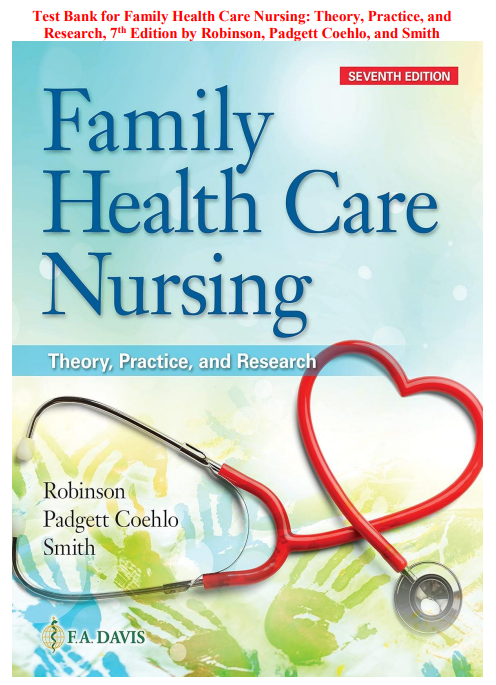
Family Health Care Nursing: Theory, Practice, and Research, 7th Edition brings together the theoretical foundations, clinical application frameworks, and research evidence that define family nursing as a distinct and sophisticated area of practice. It equips advanced practice nurses, family nurse practitioners, and community and public health nurses to work with families across every stage of the family life cycle and every healthcare setting.
This test bank was built to match it. Every question is grounded in the theoretical frameworks, clinical tools, and research perspectives the 7th edition uses. You do not just learn about family nursing. You practice applying it — to complex family scenarios, ethical dilemmas, clinical assessment situations, and research-informed practice decisions that reflect what family nursing actually looks like in the real world.
What Is Inside
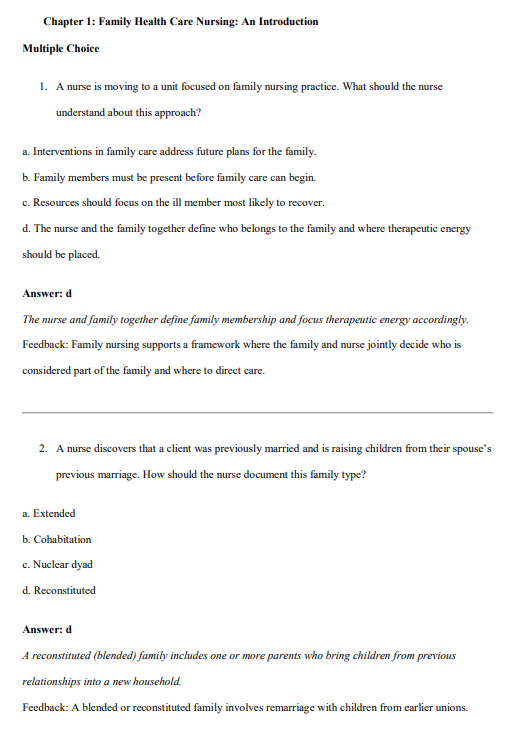
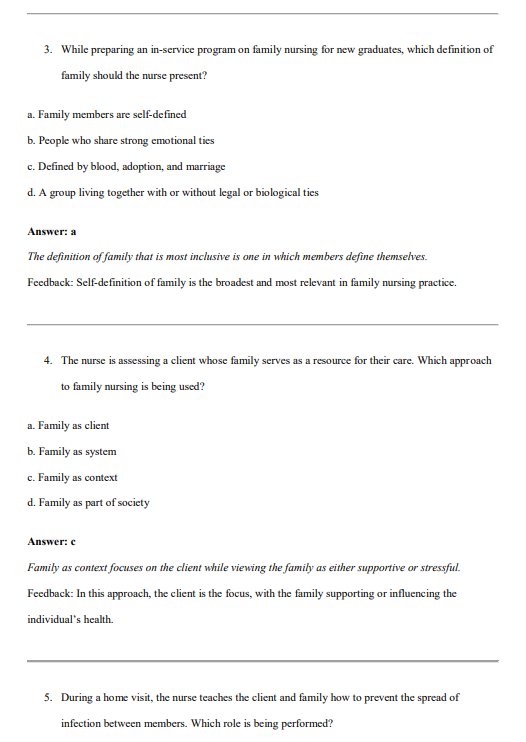
You get over a thousand practice questions covering every major theoretical framework, clinical practice domain, and research area in the 7th edition. Questions are written in multiple-choice, select-all-that-apply, and ordered response formats — consistent with what you will encounter on advanced practice nursing course exams and certification examinations.
Every question has a clearly marked correct answer. Every answer includes a full written rationale. The rationale explains the theoretical or clinical reasoning behind the correct choice, connects it to the specific framework or research evidence the textbook uses, and addresses why each wrong option reflects an incomplete or inaccurate understanding of family nursing practice. At the advanced practice and graduate level, that depth of reasoning is what separates theoretical literacy from genuine clinical competence.
Topics Covered
The test bank follows the complete structure of the 7th edition across every major content domain, including:
Foundations of Family Health Care Nursing — definition and scope of family nursing practice, historical development of family nursing as a discipline, levels of family nursing practice from family as context through family as client, the nurse’s role with families across healthcare settings, interprofessional collaboration in family-centered care, and social determinants of health and their impact on family health outcomes
Family Nursing Theory — systems theory and its application to family nursing, family stress theory including the Double ABCX model, structural-functional theory of family organization, developmental theory and the family life cycle, Bowen family systems theory, family resilience theory, and the integration of multiple theoretical frameworks into family nursing assessment and intervention
Family Assessment Frameworks and Tools — the Calgary Family Assessment Model including structural, developmental, and functional dimensions of family assessment, the Calgary Family Intervention Model, genogram construction and interpretation, ecomap development and clinical use, family health routines and rituals assessment, the Friedman Family Assessment Model, and family strengths-based assessment approaches
Family Nursing Intervention — therapeutic conversations with families, family meetings and family conferencing, psychoeducation for families managing chronic illness, family-focused health promotion interventions, family crisis intervention, supporting family caregivers, and matching intervention intensity to family need
Families Across the Life Cycle — family formation and the transition to parenthood, families with infants and young children, families with school-age children, families with adolescents, families in the middle years, aging families and later-life transitions, grandparents raising grandchildren, multigenerational family structures, and end-of-life care within the family context
Diverse Family Structures and Contexts — single-parent families, blended and stepfamilies, same-sex parent families, cohabiting families, adoptive and foster families, military families, immigrant and refugee families, and culturally diverse family structures and their implications for nursing practice
Families and Chronic Illness — family responses to chronic illness diagnosis, illness trajectory and family adaptation, caregiver burden and caregiver health, family management of chronic conditions, the impact of chronic illness on family roles and relationships, supporting family resilience in chronic illness, and nursing interventions for families living with specific chronic conditions
Families and Mental Health — family responses to mental illness, family burden in psychiatric conditions, family psychoeducation evidence base, supporting families of members with substance use disorders, children and adolescents in families with mental illness, and the intersection of family functioning and individual mental health outcomes
Families and Acute and Critical Illness — family responses to sudden illness and hospitalization, supporting families in the emergency department, family-centered care in the ICU, family presence during resuscitation, family communication with the healthcare team during acute illness, and family needs during transition from acute to home care
Families and Community and Public Health — family nursing in community health settings, school nursing and family engagement, occupational health and family health, home visiting programs and family health outcomes, refugee and immigrant family health, rural family health nursing, and public health nursing interventions at the family level
Families and Vulnerable Populations — family nursing with low-income families, families experiencing homelessness, families affected by domestic violence and intimate partner violence, families with incarcerated members, families living with HIV, and families navigating the child welfare system
Genomics and Family Health — principles of genetics and genomics relevant to family nursing, family health history collection and pedigree construction, genomic risk assessment in family nursing practice, communicating genetic risk information to families, and the nurse’s role in genomics-informed family care
Ethics in Family Nursing — ethical principles applied to family nursing practice, confidentiality and privacy within family systems, surrogate decision-making and family conflict, ethical issues in family research, and navigating competing interests of individual family members in nursing care
Family Nursing Research — research designs appropriate for family nursing inquiry, qualitative and quantitative family nursing research methods, mixed methods approaches in family research, measurement instruments used in family nursing research, evidence-based practice in family nursing, and translating family nursing research into clinical practice
Who Should Use This
This test bank is the right resource for graduate nursing students in family nurse practitioner, community health, and advanced practice programs whose courses use Kaakinen’s 7th edition, undergraduate nursing students in programs that include family nursing theory and practice content as part of their curriculum, nursing faculty teaching family nursing theory or family health promotion courses who need a theoretically grounded and clinically relevant question pool for building assessments, advanced practice nurses working with families in community, primary care, or specialty settings who want to deepen their theoretical understanding and clinical application skills, and DNP and PhD nursing students who need to engage with family nursing research frameworks and evidence-based family intervention content at a graduate level of rigor.
Why the 7th Edition Specifically
Family nursing theory, research, and clinical practice continue to evolve. The 7th edition reflects significant updates including expanded content on diverse and non-traditional family structures, updated research evidence across family nursing intervention domains, deeper integration of social determinants of health and health equity within the family nursing framework, stronger emphasis on trauma-informed family care, revised content on genomics and family health, and updated coverage of family nursing in digital and telehealth environments.
This test bank was written to align with the 7th edition specifically. The theoretical frameworks, assessment tools, clinical scenarios, and research perspectives in the questions reflect what is in this edition. If your course uses the 7th edition, this is the resource that matches it directly.
5 Sample Questions
Question 1 A family nurse practitioner is using the Calgary Family Assessment Model to assess a family whose adult son was recently diagnosed with early-onset Parkinson’s disease. Which assessment domain within the CFAM would best capture how the family members’ roles and daily routines have shifted since the diagnosis?
A. Structural assessment — examining how the family is organized and who the members are B. Developmental assessment — exploring the stage of the family life cycle and its associated tasks C. Functional assessment — examining instrumental and expressive daily functioning within the family D. Contextual assessment — exploring the community and environmental factors surrounding the family
Correct Answer: C The functional dimension of the Calgary Family Assessment Model examines how family members actually behave toward one another in daily life — including instrumental functioning such as task completion, role performance, and daily routines, and expressive functioning such as emotional communication, problem-solving, and role flexibility. When a family member is diagnosed with a chronic condition like Parkinson’s disease, the most immediate and visible changes occur in how daily tasks are redistributed and how family roles shift to accommodate new caregiving demands. The functional assessment is the dimension that captures those changes. Structural assessment identifies who the family is. Developmental assessment examines where the family is in its life cycle. Contextual assessment looks at external environment and community.
Question 2 A nurse is working with a family using the Double ABCX model of family stress and adaptation. The family recently experienced the death of a grandparent who lived in the home, a job loss, and a child’s new diagnosis of type 1 diabetes — all within six months. According to the model, which concept best describes the family’s current situation?
A. The family is experiencing a normative stressor that most families encounter and resolve without professional support B. The family is experiencing pile-up, in which multiple stressors accumulate and overwhelm the family’s existing resources and coping strategies C. The family has entered a regenerative phase in which new resources automatically replace those depleted by stressors D. The family’s perception of the stressors is the only relevant factor — the number and type of stressors are clinically irrelevant
Correct Answer: B The Double ABCX model, developed by McCubbin and Patterson building on Hill’s original ABCX model, identifies pile-up — called the aA factor — as the accumulation of multiple stressors, transitions, and strains over time that collectively overwhelm a family’s adaptive capacity. This family has experienced bereavement, financial disruption, and a new chronic illness diagnosis in rapid succession. Each stressor individually would demand significant family adaptation. Together they represent a pile-up that taxes resources, strains coping mechanisms, and increases vulnerability to family crisis. The nurse’s role is to help the family identify and mobilize new resources — the bB factor — and reframe their perception of the situation — the cC factor — to support adaptation.
Question 3 A community health nurse is conducting a home visit with a family and uses a genogram as part of the assessment. During the process, the nurse learns that the maternal grandmother and two maternal aunts have had breast cancer, and the patient — a 34-year-old woman — has never had genetic counseling or mammography. Which nursing action is most consistent with genomics-informed family nursing practice?
A. Reassure the patient that breast cancer is common and her personal risk is not necessarily elevated B. Document the family history in the genogram and refer the patient to her primary care provider for genomic risk assessment and appropriate screening C. Advise the patient to begin monthly self-breast examinations and recheck in one year D. Inform the patient that genetic testing is only appropriate after age 40 and no action is needed at this time
Correct Answer: B A three-generation family history of breast cancer on the maternal side is a significant genomic risk indicator. The BRCA1 and BRCA2 gene mutations, as well as other hereditary breast cancer syndromes, follow patterns visible in a well-constructed genogram. At 34 years old with this family history, this patient has not received appropriate genetic counseling or risk-stratified screening. The family nurse’s role is to recognize the pattern, document it accurately in the genogram, and refer the patient for formal genomic risk assessment with a provider who can order appropriate testing and counseling. Reassurance, delayed action, or self-examination alone is clinically insufficient for a patient with this family history.
Question 4 A nurse is caring for a family in the ICU whose father is on mechanical ventilation following a massive stroke. The adult children are divided — two want to pursue all aggressive interventions, and one wants to transition to comfort-focused care in alignment with what they believe their father would have wanted. There is no advance directive. Which nursing approach best reflects ethical family nursing practice?
A. Support the majority decision of the two children who want aggressive intervention since they outnumber the other sibling B. Defer entirely to the medical team’s recommendation without involving the family further to avoid conflict C. Facilitate a structured family meeting that creates space for each family member to be heard, provides clear clinical information, and supports the family in reaching a shared decision centered on the patient’s values D. Encourage the family to hire an attorney to resolve the disagreement before any further care decisions are made
Correct Answer: C When families face high-stakes end-of-life decisions without an advance directive, the nurse’s role is to facilitate communication, not arbitrate the outcome. A structured family meeting — ideally with interprofessional support including social work, chaplaincy, and palliative care — creates a therapeutic space where each family member’s perspective is validated, clinical realities are communicated clearly and compassionately, and the focus is redirected toward what the patient would have wanted rather than what each family member prefers. Deferring to the majority vote treats a values-based decision as a democratic process, which is inappropriate. Removing the family from the process or escalating to legal intervention before communication strategies are exhausted is premature and potentially harmful to the family system.
Question 5 A family nurse is applying family resilience theory to a family who has just learned that their 8-year-old child has been diagnosed with leukemia. The parents appear overwhelmed, tearful, and report feeling completely unprepared. Which nursing intervention most directly supports family resilience at this early stage?
A. Provide the family with a detailed written summary of the child’s prognosis and five-year survival statistics to help them prepare for the road ahead B. Acknowledge the family’s distress, identify existing strengths and resources within the family, and connect them with peer support families who have navigated a similar diagnosis C. Advise the family to focus on staying positive and avoid discussing the diagnosis with extended family members until a treatment plan is established D. Refer the family immediately to a psychiatrist since their emotional response indicates a risk for adjustment disorder
Correct Answer: B Family resilience theory, associated with the work of Froma Walsh, focuses on identifying and activating the protective processes that allow families to navigate adversity. In the immediate aftermath of a devastating diagnosis, the nurse’s role is not to deliver prognostic statistics — which can overwhelm rather than inform at this stage — but to normalize the family’s emotional response, help them recognize the strengths they already possess, and connect them to resources including peer support, which has strong evidence for reducing isolation and building coping capacity in families of children with serious illness. Advising suppression of emotional expression or social support seeking undermines resilience. A tearful, overwhelmed response to a child’s cancer diagnosis is a normal human reaction, not a psychiatric emergency.
Frequently Asked Questions
Is this the official F.A. Davis test bank for the 7th edition? No. This is an independently developed study resource based on the content of the 7th edition. It is not published or endorsed by F.A. Davis or the original authors. It is a supplementary exam preparation and clinical learning tool for nursing students and faculty.
How many questions are in the test bank? There are over a thousand questions distributed across all major theoretical, clinical, and research content areas in the 7th edition, with strong representation in the highest-yield areas including family assessment frameworks, chronic illness nursing, family theory application, and ethical decision-making with families.
This is a graduate-level textbook. Is the test bank written at that level? Yes. The questions are written at the application and analysis levels appropriate for graduate and advanced practice nursing programs. Many items present complex family scenarios that require you to select and apply a specific theoretical framework, choose between competing ethical positions, or differentiate between similar family assessment approaches. This is consistent with the cognitive demands of graduate nursing coursework and advanced practice certification examinations.
I am an undergraduate student whose program includes family nursing content. Is this test bank too advanced? Not necessarily. The foundational chapters on family theory, the family life cycle, family assessment, and family responses to illness are highly accessible and directly relevant to undergraduate nursing students beginning to think about families as units of care. The more advanced theoretical and research content is better suited to graduate-level study.
How does this test bank support family nurse practitioner certification preparation? Family nursing theory, assessment, and intervention are core competencies for FNP practice. Many FNP certification examination blueprints include family-centered care content, and the theoretical and clinical frameworks in this test bank — particularly the Calgary Family Assessment Model, family stress theory, and family resilience frameworks — prepare students to engage with those competencies at the level the examination requires.
Does every question include a rationale? Yes, without exception. Every question has a correct answer and a full written rationale that explains the theoretical or clinical reasoning behind the correct choice and addresses why each wrong option reflects a misapplication or misunderstanding of family nursing theory or practice. In a content area built on theoretical frameworks, understanding the reasoning behind each answer is what builds genuine family nursing competency.
Can nursing faculty use this to build family nursing course assessments? Yes. Questions are organized by chapter and content domain, making it straightforward to build unit exams, case-based assessments, or comprehensive finals that test both theoretical literacy and clinical application. The questions are written at the cognitive complexity appropriate for graduate family nursing courses and can be adapted for use in both online and in-person assessment formats.
What file format is the test bank delivered in? It comes as a digital file, typically in Word or PDF format. You can search by theoretical framework, clinical population, or content domain, print specific chapters for focused study sessions, and access it across multiple devices. Many graduate students use it to build theoretical fluency by working through all questions related to a single framework — such as the CFAM or the Double ABCX model — before moving to questions that require integrating multiple frameworks.
Is this test bank specific to the 7th edition only? Yes. It was written to align with the theoretical frameworks, updated research content, diverse family structures coverage, and clinical application frameworks of the 7th edition. Earlier editions have different organizational structures and do not reflect the updated social determinants, genomics, and telehealth content added in the 7th edition. Always confirm your course edition before purchasing.
Caleb Martins –
Perfect
Norah Helen –
A very good study guide
Winnie M. –
much better than I expected