
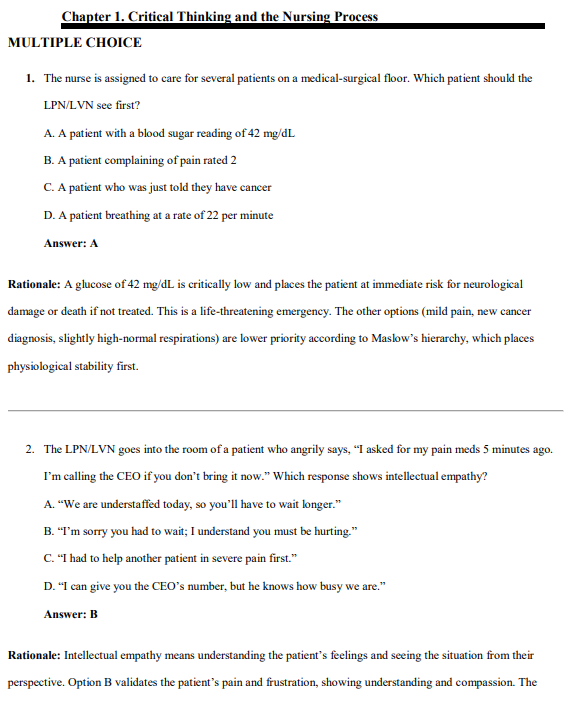

Medical-surgical nursing forms the backbone of nursing practice. This test bank supports the seventh edition of Williams and Hopper’s comprehensive textbook. It provides essential practice for students tackling this challenging core course.
Extensive Practice Question Library
This test bank offers thousands of practice questions across all chapters. You’ll find multiple-choice, select-all-that-apply, and prioritization questions. Clinical case scenarios test your ability to apply knowledge practically. Fill-in-the-blank calculations challenge your dosage computation skills.
Every question includes the correct answer with comprehensive rationales. You learn the reasoning behind each correct response. Explanations for incorrect options prevent future mistakes. This thorough feedback approach accelerates your learning significantly.
Why Medical-Surgical Students Need This
Medical-surgical nursing covers an overwhelming amount of information. Every body system and countless disease processes. Pharmacology, pathophysiology, and nursing interventions all combined. Without structured practice, retention becomes nearly impossible.
This test bank organizes massive content into manageable sections. Practice questions by body system or disease category. Focus on cardiovascular today, respiratory tomorrow. This systematic approach prevents cognitive overload completely.
Instructors often pull exam questions from similar test banks. Familiarity with question formats reduces anxiety substantially. You’ll recognize patterns and anticipate what examiners want. This advantage translates directly into better scores.
Complete Body System Coverage
Cardiovascular questions address heart disease comprehensively. Myocardial infarction, heart failure, and valve disorders appear frequently. Dysrhythmia recognition and treatment questions test critical knowledge. Hypertension management and vascular disease receive thorough attention.
Respiratory system questions cover both acute and chronic conditions. Pneumonia, COPD, and asthma management scenarios. Mechanical ventilation and oxygen therapy applications. Thoracic surgery and chest tube management appear regularly.
Gastrointestinal questions span upper and lower tract conditions. Peptic ulcers, inflammatory bowel disease, and bowel obstructions. Liver disease including cirrhosis and hepatitis complications. Nutritional support and feeding tube management integrate throughout.
Neurological questions challenge your critical thinking abilities. Stroke assessment and intervention timelines. Increased intracranial pressure recognition and management. Seizure disorders and spinal cord injuries require specialized knowledge.
Perioperative Nursing Focus
Preoperative assessment questions prepare you for surgical nursing. Patient teaching and informed consent considerations. Anxiety management and medication administration. NPO status and aspiration prevention receive attention.
Intraoperative questions address anesthesia and positioning concerns. Surgical site infection prevention strategies. Sterile technique and operating room safety principles. These questions develop surgical nursing competence.
Postoperative care receives extensive question coverage. Pain management using pharmacological and non-pharmacological methods. Surgical complication recognition including hemorrhage and infection. Wound healing assessment and drain management appear frequently.
Oncology and End-of-Life Care
Cancer nursing questions address all treatment modalities. Chemotherapy administration and side effect management. Radiation therapy effects and patient teaching. Immunotherapy and targeted therapy newer treatments.
Symptom management questions prepare you for palliative care. Pain assessment and control across patient populations. Nausea, fatigue, and anorexia interventions. Psychosocial support for patients and families.
End-of-life care questions address sensitive situations compassionately. Advance directives and patient autonomy issues. Hospice care principles and family support. Grief and bereavement support for survivors.
Chronic Disease Management
Diabetes questions cover both Type 1 and Type 2 thoroughly. Blood glucose monitoring and insulin administration. Oral hypoglycemic agents and newer injectable medications. Acute complications like DKA and hyperosmolar states.
Chronic kidney disease progression and management. Dialysis modalities and vascular access care. Fluid and electrolyte balance in renal failure. Transplantation considerations and immunosuppression therapy.
Autoimmune disorders receive appropriate coverage. Rheumatoid arthritis and systemic lupus erythematosus. Medication management including biologics and DMARDs. Joint protection and pain management strategies.
Emergency and Critical Care
Shock questions test your understanding of different types. Hypovolemic, cardiogenic, distributive, and obstructive shock. Early recognition and immediate intervention priorities. Fluid resuscitation and vasopressor support.
Acute respiratory failure recognition and management. ARDS pathophysiology and ventilator strategies. Non-invasive ventilation applications and weaning protocols. Airway management and emergency intubation assistance.
Trauma questions address multiple injury scenarios. Abdominal trauma and internal bleeding recognition. Head injuries and Glasgow Coma Scale assessment. Burn injuries across severity levels and treatment phases.
Infection Control and Safety
Healthcare-associated infection prevention appears throughout. Hand hygiene compliance and standard precautions. Transmission-based precautions for different organisms. Central line and catheter-associated infection prevention.
Antibiotic stewardship questions address appropriate medication use. MRSA and VRE management and isolation requirements. Clostridium difficile prevention and treatment protocols. Emerging resistant organisms and infection control measures.
Patient safety questions emphasize fall prevention strategies. Medication safety and error reduction approaches. Patient identification and communication handoffs. Alarm fatigue and monitoring system management.
Pharmacology Integration
Medication questions appear throughout all body systems. Drug classifications and mechanisms of action. Side effects, adverse reactions, and contraindications. Drug interactions and patient teaching requirements.
High-alert medication questions demand extra attention. Anticoagulants including warfarin and newer agents. Insulin administration and dosage adjustments. Opioid analgesics and safety monitoring requirements.
Intravenous therapy questions address administration competencies. Peripheral and central venous access devices. Infusion rate calculations and pump programming. Complication recognition including infiltration and phlebitis.
Patient Education Emphasis
Teaching questions appear across all disease processes. Discharge planning and home care instructions. Medication compliance and side effect reporting. Lifestyle modifications and disease self-management.
Health literacy considerations integrate into teaching scenarios. Plain language explanations and teach-back methods. Cultural competence in patient education delivery. Family involvement and support system engagement.
Technology-based teaching tools and telehealth applications. Remote monitoring and patient portal usage. Mobile health applications and wearable devices. These contemporary topics reflect modern nursing practice.
Critical Thinking Development
Medical-surgical nursing requires excellent clinical judgment. This test bank progressively develops that essential skill. Basic knowledge questions establish foundations first. Complex application questions follow naturally.
Priority-setting questions appear extensively throughout. Which patient assessment occurs first? What intervention takes immediate precedence? These decisions mirror real nursing responsibilities daily.
Delegation questions prepare you for charge nurse roles. Appropriate task assignment to unlicensed personnel. Supervision requirements and accountability issues. Team nursing and leadership responsibilities.
NCLEX-RN Preparation
Medical-surgical content dominates NCLEX examinations heavily. This test bank builds essential knowledge foundations. Question formats match next-generation NCLEX items. Clinical judgment measurement model scenarios appear throughout.
Safe and effective care environment questions emphasize management. Pharmacological and parenteral therapies receive proportional coverage. Physiological adaptation questions challenge your pathophysiology understanding. These categories align perfectly with NCLEX blueprints.
Repeated practice with NCLEX-style questions builds confidence. You’ll recognize question stems and understand expectations. Test-taking strategies develop through consistent exposure. Success rates improve dramatically with adequate practice.
Study Efficiency Maximized
Medical-surgical courses move incredibly fast. New content arrives before previous material solidifies. Efficient study methods become absolutely critical. This test bank streamlines your preparation time.
Ready-made questions eliminate hours of study guide creation. Jump directly into productive practice sessions. Identify knowledge gaps immediately and address them. This focused approach maximizes limited study time.
Portable digital access enables studying anywhere conveniently. Practice during clinical breaks or commutes. Review difficult questions repeatedly until mastered. Small consistent efforts produce better results than cramming.
Career Foundation Building
Medical-surgical nursing knowledge applies across practice settings. Hospital floor nursing requires these competencies daily. Clinic nursing and outpatient care use identical foundations. Home health and rehabilitation nursing build on these principles.
Many specialty certifications require medical-surgical knowledge first. Critical care and emergency nursing expand these basics. Perioperative and oncology certifications build upon fundamentals. Strong medical-surgical foundations support career advancement significantly.
Invest in your nursing future with thorough preparation. Master medical-surgical content through comprehensive practice. Build confidence that translates to excellent patient care. Your future career success begins with solid academic performance.
Rachael K –
Finally understood Med-Surg thanks to these practice questions!
Benjamin Graham –
Perfectly organized top quality resource
Foster867 –
Straight to the point
Bennytah –
Well worth the money
Stephanie Laura –
A solid study help. Must have for every med-surg student
Gerald M. –
Saved me lot of time and money.
Purityk –
Perfect
Helen Christie –
Very very good
Carol Kay –
Well worth the money
Peterson S. –
Extremely useful
Mary Lincoln –
Very relevant practice questions
Lisa Horton –
Not only comprehensive but also very detailed
Caleb Martins –
Boosted my confidence greatly
Kevin May –
Very useful study resource
Norah Helen –
Accurate and challenging questions
Lucas Gabriel –
Great explanations and realistic questions
Yunice M –
Excellent nursing test bank, very helpful practice
Mary Lincoln –
Perfect study tool for nursing success
Melania Angel –
Good variety of questions across nursing subjects