

Critical care nursing asks more of a nurse than almost any other specialty in healthcare. The patients are the sickest. The technology is the most complex. The clinical decisions carry the highest stakes. And the window between a patient who is declining and a patient who is crashing can be measured in minutes rather than hours.
What separates a competent critical care nurse from a great one is not just technical skill. It is the ability to hold the whole patient in mind simultaneously — the hemodynamic numbers and the frightened family member in the waiting room. The ventilator settings and the patient’s values about resuscitation. The sepsis bundle and the human being inside the diagnosis. That integration of clinical precision and holistic, patient-centered thinking is exactly what Morton and Fontaine’s Critical Care Nursing: A Holistic Approach has built its reputation on across more than four decades of editions.
The 12th edition carries that tradition forward with updated evidence-based clinical content, expanded holistic and palliative care integration, current Surviving Sepsis Campaign guidelines, revised mechanical ventilation management, updated PADIS framework content, and deeper engagement with the ethical and humanistic dimensions of intensive care nursing that no algorithm or protocol can capture alone.
This test bank was built to match it. Every question reflects the dual commitment of the 12th edition — clinical rigor and holistic care. You practice not just recognizing the hemodynamic crisis but responding to it in a way that keeps the whole patient at the center. That integration is what the CCRN tests, what the bedside demands, and what this test bank builds.
What Is Inside
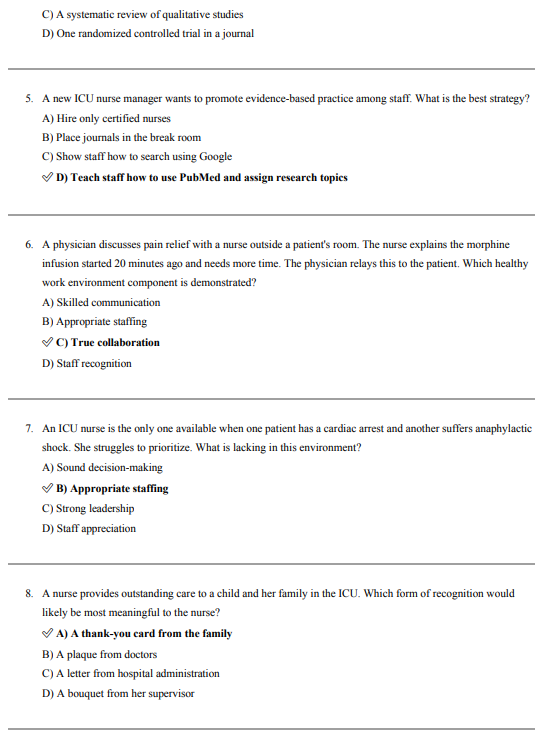
You get over a thousand practice questions covering every major critical care system, condition, monitoring concept, and holistic care domain in Morton and Fontaine’s 12th edition. Questions are written in multiple-choice, select-all-that-apply, and ordered response formats — consistent with what you will encounter on advanced nursing course exams, the NCLEX-RN, and the CCRN certification examination.
Every question has a clearly marked correct answer. Every answer includes a full written rationale. The rationale explains the pathophysiological reasoning, hemodynamic principle, evidence-based guideline, or holistic care consideration behind the correct choice and addresses specifically why each wrong option is clinically incorrect, guideline-discordant, or insufficiently holistic. In critical care, that depth of explanation is not optional — it is what builds the clinical judgment and humanistic sensitivity that ICU nursing demands.
Topics Covered
The test bank follows the complete structure of the 12th edition across every major content domain, including:
Foundations of Holistic Critical Care Nursing — the critical care nursing role and scope of practice, the AACN Synergy Model for patient care, holistic care philosophy in critical illness, ethical decision-making in the ICU, end-of-life care and dying with dignity in critical settings, family-centered critical care and visitation policy, palliative care integration in the ICU, cultural humility and diversity in critical care nursing, spiritual care in critical illness, and the nurse’s role in promoting humanistic care in a technology-dominated environment
Patient Safety and Quality in the ICU — National Patient Safety Goals in the ICU, the ICU liberation bundle including A through F components, preventing ICU-acquired complications including catheter-associated urinary tract infections, central line-associated bloodstream infections, ventilator-associated events, and pressure injuries, medication safety in critical care, handoff communication in the ICU, and quality improvement initiatives in critical care nursing
Pain, Agitation, Delirium, Immobility, and Sleep — the PADIS guidelines comprehensive framework, pain assessment in non-verbal and mechanically ventilated patients using validated tools, analgesic pharmacology in critical illness, sedation assessment using RASS and SAS scales, sedation minimization and daily awakening trials, delirium assessment using CAM-ICU and ICDSC, delirium prevention and non-pharmacologic management, early mobility protocols and nursing implementation, sleep promotion in the ICU, and the ABCDEF bundle as an integrated approach
Hemodynamic Monitoring — arterial line insertion site selection, setup, zeroing, and waveform interpretation including dicrotic notch identification, central venous catheter types and CVP monitoring, pulmonary artery catheter components and hemodynamic profiles, cardiac output measurement techniques, stroke volume and stroke volume variation, mixed and central venous oxygen saturation interpretation and clinical significance, troubleshooting common hemodynamic monitoring problems, and point-of-care echocardiography basics for nursing
Cardiovascular Critical Care — pathophysiology and nursing management of acute coronary syndromes including STEMI and NSTEMI, cardiogenic shock hemodynamic profile and management, acute decompensated heart failure and pulmonary edema, hypertensive emergencies in the ICU, life-threatening dysrhythmia recognition and management including ventricular fibrillation, ventricular tachycardia, complete heart block, and atrial fibrillation with rapid ventricular response, temporary transvenous and transcutaneous cardiac pacing, intra-aortic balloon pump therapy and weaning, left ventricular assist device nursing care, post-cardiac surgery nursing management, targeted temperature management after cardiac arrest, and pericardial tamponade recognition and management
Pulmonary Critical Care — acute respiratory failure pathophysiology and classification, mechanical ventilation modes including volume control, pressure control, SIMV, pressure support, and APRV, lung-protective ventilation in ARDS based on current evidence, ventilator-associated pneumonia prevention bundles, non-invasive positive pressure ventilation including CPAP and BiPAP nursing management, high-flow nasal cannula therapy, ventilator weaning and spontaneous breathing trial protocols, extubation readiness assessment, acute respiratory distress syndrome management, massive pulmonary embolism in the ICU, pleural space emergencies, severe asthma and status asthmaticus, and tracheostomy care in the ICU
Neurological Critical Care — comprehensive neurological assessment in the ICU, intracranial pressure monitoring modalities and waveform interpretation, cerebral perfusion pressure management, traumatic brain injury grading and evidence-based management, ischemic stroke in the ICU including thrombolytic administration and endovascular therapy nursing care, hemorrhagic stroke and subarachnoid hemorrhage nursing management, cerebral vasospasm recognition and management, status epilepticus pharmacologic management, Guillain-Barré syndrome progression monitoring, myasthenic crisis nursing care, spinal cord injury management in the ICU, brain death determination process and organ donation nursing role, and post-neurosurgical critical care
Shock and Multisystem Failure — pathophysiology of hypovolemic, distributive, cardiogenic, and obstructive shock, sepsis and septic shock recognition using current Surviving Sepsis Campaign guidelines including qSOFA and SOFA criteria, one-hour sepsis bundle implementation, vasopressor and inotrope pharmacology and titration nursing responsibilities, systemic inflammatory response syndrome, multiple organ dysfunction syndrome progression and nursing management, disseminated intravascular coagulation recognition and nursing care, and anaphylactic shock emergency management
Renal Critical Care — acute kidney injury pathophysiology and KDIGO staging, causes and prevention of AKI in the ICU including contrast nephropathy and nephrotoxic drug avoidance, continuous renal replacement therapy modalities including CRRT, CVVH, CVVHD, and CVVHDF, CRRT circuit setup, anticoagulation, and troubleshooting, electrolyte emergencies including hyperkalemia, hyponatremia, hypophosphatemia, and hypomagnesemia, rhabdomyolysis recognition and management, fluid resuscitation and fluid balance monitoring in critical illness, and hepatorenal syndrome
Gastrointestinal Critical Care — upper and lower gastrointestinal hemorrhage in the ICU, acute liver failure and hepatic encephalopathy management, acute pancreatitis severity assessment and ICU management, abdominal compartment syndrome monitoring and intervention, stress ulcer prophylaxis current evidence and indications, mesenteric ischemia recognition, enteral and parenteral nutrition in critical illness, and ileus prevention and management in the ICU
Endocrine Critical Care — diabetic ketoacidosis management including insulin infusion protocols, hyperosmolar hyperglycemic state management, stress hyperglycemia and glycemic control targets in the ICU, adrenal insufficiency in critical illness and hydrocortisone administration, thyroid storm recognition and emergency management, myxedema coma, syndrome of inappropriate antidiuretic hormone, and diabetes insipidus in the ICU
Hematologic and Immunologic Critical Care — coagulation disorders in the ICU, disseminated intravascular coagulation, heparin-induced thrombocytopenia recognition and management, massive transfusion protocols and damage control resuscitation, transfusion reactions recognition and nursing management, neutropenic precautions and febrile neutropenia, care of immunocompromised patients in the ICU, and bone marrow transplant critical care considerations
Trauma and Burns — primary and secondary trauma surveys, traumatic brain injury and spinal cord injury management, thoracic trauma including pneumothorax, hemothorax, and flail chest, abdominal trauma and damage control surgery nursing, pelvic trauma and hemorrhage control, burn injury assessment using the rule of nines and Lund-Browder chart, Parkland formula fluid resuscitation nursing management, inhalation injury assessment and management, burn wound care and infection prevention, and rehabilitation considerations in burn nursing
Multisystem and Toxicological Emergencies — overdose and poisoning management in the ICU, toxidrome recognition and antidote administration, alcohol withdrawal delirium assessment and pharmacologic management, serotonin syndrome recognition and management, neuroleptic malignant syndrome, heat stroke and severe hypothermia management, and near-drowning critical care
Holistic Dimensions of Critical Care — spiritual care needs assessment in the ICU, cultural considerations in critical illness and end-of-life decision-making, compassion fatigue and burnout in critical care nurses, self-care and resilience for ICU nurses, debriefing after difficult cases, nurse-family communication strategies, navigating family conflict in end-of-life care, and the nurse’s role in promoting dignity and comfort throughout critical illness
Who Should Use This
This test bank is the right resource for nursing students enrolled in a critical care nursing course whose program uses Morton and Fontaine’s 12th edition, NCLEX-RN candidates who want to strengthen performance on the highest-acuity priority and management of care questions in the critical care content area, registered nurses preparing for CCRN certification who need comprehensive system-by-system question-based practice aligned with the AACN certification blueprint, new graduate nurses transitioning into ICU or step-down environments who want to accelerate clinical reasoning development and build pattern recognition before or during orientation, nurses transitioning from other specialties into critical care who need a structured review of ICU-specific knowledge and skills, and nursing faculty teaching critical care courses who need a holistic, evidence-aligned, and clinically rigorous question pool for building course and competency assessments.
Why the 12th Edition Specifically
Critical care medicine and nursing practice evolve faster than almost any other specialty. The 12th edition of Morton and Fontaine reflects the most current evidence across every major content domain — including updated PADIS guidelines for pain, agitation, delirium, immobility, and sleep, current Surviving Sepsis Campaign one-hour bundle recommendations, updated lung-protective ventilation evidence including the PROSEVA prone positioning trial and its implications, current KDIGO acute kidney injury staging criteria, revised targeted temperature management evidence after cardiac arrest, expanded palliative care integration throughout, and updated content on health equity and diversity in critical care populations.
This test bank was written to align with the 12th edition specifically. If your course or CCRN preparation uses the 12th edition, this is the test bank that matches it.
5 Sample Questions
Question 1
A nurse is caring for a patient with septic shock on norepinephrine 0.18 mcg/kg/min. The mean arterial pressure is 61 mmHg. The patient has received 30 mL/kg of IV crystalloid. Serum lactate drawn two hours ago was 4.2 mmol/L. A repeat lactate has just resulted at 5.8 mmol/L. Urine output for the past two hours is 18 mL total. Which interpretation and nursing action is most appropriate?
A. The MAP of 61 mmHg meets the target of 65 mmHg — continue current management and recheck lactate in four hours
B. Rising lactate and persistent oliguria indicate worsening tissue hypoperfusion despite vasopressor support — notify the provider immediately and anticipate escalation of vasopressors and possible addition of vasopressin
C. The rising lactate is likely a laboratory error — repeat the sample before making any management changes
D. Reduce the norepinephrine rate since the MAP is above 60 mmHg and further vasoconstriction may worsen tissue perfusion
Correct Answer: B
A MAP of 61 mmHg falls below the Surviving Sepsis Campaign target of 65 mmHg, and the clinical trajectory is worsening — rising lactate from 4.2 to 5.8 mmol/L and oliguria of only 18 mL over two hours are signs of escalating tissue hypoperfusion despite vasopressor support and adequate fluid resuscitation. This is a clinical deterioration requiring immediate provider notification. Anticipated interventions include increasing norepinephrine, adding vasopressin as a second vasopressor per current guidelines, and reassessing the fluid status for ongoing fluid responsiveness. A rising lactate in this context is not a laboratory error — it is a metabolic marker of inadequate oxygen delivery that demands clinical action. Reducing the vasopressor when MAP is already below target and lactate is rising would further compromise perfusion.
Question 2
A nurse is performing a morning assessment on a 72-year-old patient who has been in the medical ICU for five days following a severe pneumonia. The patient was alert and oriented to person and place yesterday but today does not recognize the nurse, keeps trying to pull out the nasogastric tube, and is asking for people who are not present. RASS score is +2. CAM-ICU assessment is positive. Which interpretation and intervention best reflects the holistic nursing approach of the 12th edition?
A. The patient is at high risk for self-harm — apply wrist restraints bilaterally and administer haloperidol as a chemical restraint
B. The patient has ICU delirium — implement non-pharmacologic reorientation interventions, minimize sedatives especially benzodiazepines, promote sleep, involve family in reorientation, facilitate early mobility if safe, and notify the provider
C. The patient is experiencing expected confusion from being in an unfamiliar environment — reassure the patient and recheck orientation at the next scheduled assessment
D. The patient is showing signs of dementia that were likely present before admission — document the finding and adjust the care plan to reflect a new baseline
Correct Answer: B
The acute change from oriented yesterday to confused today, combined with a positive CAM-ICU, confirms ICU delirium — one of the most common and clinically significant complications of critical illness. Morton and Fontaine’s holistic approach emphasizes that delirium management should begin with the most humanistic, least restrictive interventions first — reorientation by nursing staff and family, restoration of normal sleep-wake cycles, hearing aids and glasses if used, early progressive mobility, minimization of sedatives especially benzodiazepines, and environmental modifications that reduce disorienting stimuli. Restraints increase agitation and delirium burden and are not the first response. The acute onset rules out a dementia baseline explanation. Haloperidol does not have strong evidence for delirium prevention or treatment and is not a first-line intervention.
Question 3
A nurse is managing a patient with ARDS who is on mechanical ventilation with the following settings and values: tidal volume 580 mL, predicted body weight 62 kg, FiO₂ 0.75, PEEP 10 cmH₂O, plateau pressure 32 cmH₂O, SpO₂ 90%, PaO₂ 58 mmHg. Which ventilator parameter adjustment should the nurse advocate for based on current lung-protective ventilation evidence?
A. Increase tidal volume to 700 mL to improve minute ventilation and raise PaO₂
B. Reduce PEEP to 5 cmH₂O to decrease the risk of barotrauma since plateau pressure is already elevated
C. Reduce tidal volume to approximately 6 mL/kg of predicted body weight and maintain plateau pressure below 30 cmH₂O
D. Increase FiO₂ to 1.0 immediately before adjusting any other ventilator parameters
Correct Answer: C
This patient’s tidal volume of 580 mL on a 62 kg predicted body weight equals approximately 9.4 mL/kg — well above the 4 to 6 mL/kg target established by the ARDSNet lung-protective ventilation protocol. The plateau pressure of 32 cmH₂O also exceeds the recommended ceiling of 30 cmH₂O, indicating volutrauma and barotrauma risk. Reducing the tidal volume to approximately 372 mL (6 mL/kg of 62 kg) is the priority intervention. This will likely cause permissive hypercapnia and may require tolerance of lower-than-normal pH values, which is acceptable in ARDS management. Increasing FiO₂ to 1.0 exposes the patient to oxygen toxicity without first optimizing ventilator mechanics. Reducing PEEP worsens alveolar derecruitment and oxygenation in ARDS. Increasing tidal volume worsens lung injury.
Question 4
A family member of a patient dying in the ICU approaches the nurse in tears and says: “The doctor told us there is nothing more they can do. We do not want him to suffer. But we also do not want to feel like we are giving up on him.” The nurse’s response should reflect which principle central to Morton and Fontaine’s holistic framework?
A. Redirect the family to the physician for further discussion since end-of-life decisions are outside the nurse’s scope
B. Reassure the family that choosing comfort-focused care is giving up and that they should reconsider
C. Acknowledge the family’s grief and conflict, explain that transitioning to comfort-focused care is not giving up but rather a different kind of fighting — one focused on honoring the patient’s dignity and preventing suffering
D. Tell the family they need to decide quickly since the ICU team needs a decision for bed management purposes
Correct Answer: C
This response reflects the holistic, humanistic philosophy that Morton and Fontaine’s textbook places at the heart of critical care nursing. Families in this situation are not failing their loved one — they are facing one of the most painful decisions a human being can make. The nurse’s role is to hold space for that grief, validate both the love and the conflict in what the family is feeling, and gently reframe comfort-focused care as an act of love and advocacy rather than abandonment. Redirecting to the physician without engagement abandons the family at their most vulnerable. Affirming that comfort care equals giving up reinforces guilt that does not serve the patient or family. Rushing the family for operational reasons is a profound violation of compassionate end-of-life care.
Question 5
A nurse is caring for a patient in the ICU following a massive upper gastrointestinal hemorrhage from a bleeding gastric ulcer. The patient has received four units of packed red blood cells over six hours. Current vital signs show blood pressure 86/52 mmHg, heart rate 128 beats per minute, respiratory rate 24 breaths per minute, and SpO₂ 94%. Hemoglobin is 6.2 g/dL. The patient is pale, diaphoretic, and increasingly restless. Which nursing action is the highest priority?
A. Administer a proton pump inhibitor infusion since the underlying cause of the bleed must be addressed before volume resuscitation is continued
B. Notify the provider of ongoing hemodynamic instability, prepare for activation of the massive transfusion protocol, and anticipate urgent endoscopic or surgical intervention
C. Transfuse one unit of fresh frozen plasma and reassess hemoglobin in four hours before making further management decisions
D. Place the patient in Trendelenburg position to improve cerebral perfusion and administer a 1 liter normal saline bolus
Correct Answer: B
This patient is in hemorrhagic shock — hypotension, tachycardia, tachypnea, pallor, diaphoresis, restlessness, and a hemoglobin of 6.2 g/dL despite four units of blood — indicating ongoing bleeding that is outpacing resuscitation. This is a life-threatening emergency requiring immediate provider notification, activation of the massive transfusion protocol to deliver packed red blood cells, fresh frozen plasma, and platelets in balanced ratios, and urgent preparation for definitive hemorrhage control through endoscopy or surgery. Proton pump inhibitors are important adjuncts but do not stop active hemorrhage. A single unit of FFP without a broader resuscitation plan is inadequate for a patient in hemorrhagic shock. Trendelenburg is no longer supported as a standard intervention for hemorrhagic shock and does not address the underlying blood loss.
Frequently Asked Questions
Is this the official Wolters Kluwer test bank for Morton and Fontaine’s 12th edition?
No. This is an independently developed study resource based on the content of Patricia Gonce Morton and Dorrie K. Fontaine’s 12th edition. It is not published or endorsed by Wolters Kluwer or the original authors. It is a supplementary exam and certification preparation tool for critical care nursing students and practicing ICU nurses.
How many questions are in the test bank?
There are over a thousand questions distributed across all major critical care content areas and holistic care domains in the 12th edition, with the greatest concentration in cardiovascular, pulmonary, neurological, shock and sepsis, and renal critical care — the highest-yield areas for both the NCLEX-RN and the CCRN examination.
How does this test bank differ from the ones for Sole’s 8th and 9th editions of Introduction to Critical Care Nursing?
Morton and Fontaine’s textbook has a distinct holistic philosophy that integrates palliative care, family-centered care, spiritual care, and ethical reasoning throughout every clinical chapter — not just as separate sections. This test bank reflects that integration. Questions in this test bank frequently combine clinical reasoning with holistic or ethical dimensions, reflecting the dual emphasis of Morton and Fontaine’s approach. The Sole-based test banks are more clinically focused with less explicit holistic integration.
Can this test bank help me prepare for the CCRN certification examination?
Yes. The content in Morton and Fontaine’s 12th edition maps closely to the AACN CCRN blueprint, and questions are written at the application and analysis levels the certification examination demands. It is most effective as a supplementary resource alongside a dedicated CCRN review program and practice examination.
I am transitioning from a medical-surgical unit into the ICU. Will this test bank help me during orientation?
Yes, significantly. The transition from med-surg to the ICU is one of the steepest learning curves in nursing. Working through this test bank system by system during orientation builds the hemodynamic reasoning, monitoring interpretation skills, and emergency response pattern recognition that most new ICU nurses take months to consolidate through clinical exposure alone.
Does the test bank cover the holistic and palliative care content in Morton and Fontaine’s textbook?
Yes. The holistic dimensions of critical care — including end-of-life communication, family support, spiritual care, delirium and sleep promotion, compassion fatigue, and the ethical challenges of ICU decision-making — are represented throughout the test bank, not just in a single section. This reflects the integrated approach of the 12th edition.
Does every question include a rationale?
Yes, without exception. Every question has a correct answer and a full written rationale that explains the clinical reasoning, evidence-based guideline, or holistic care principle behind the correct choice and addresses why each wrong option is clinically incorrect or insufficiently patient-centered. In critical care, understanding the reasoning behind every decision — clinical and humanistic — is what separates competent practice from excellent care.
Can nursing faculty use this to build critical care course assessments?
Yes. Questions are organized by system and content domain, making it straightforward to build unit exams, case-based assessments, or comprehensive finals that reflect both the clinical rigor and the holistic care philosophy of Morton and Fontaine’s textbook.
What file format is the test bank delivered in?
It comes as a digital file, typically in Word or PDF format. You can search by system, condition, or holistic care concept, print specific sections for focused study sessions, and access it across multiple devices.
Is this test bank specific to the 12th edition only?
Yes. It was written to align with the clinical guidelines, evidence-based protocols, holistic care framework, and content organization of the 12th edition specifically. Critical care guidelines — including sepsis bundles, ventilation strategies, and PADIS protocols — are updated frequently, and earlier editions may not reflect current evidence-based standards. Always confirm your edition before purchasing.

Peterson S. –
Perfect!
Leah Kiptum –
Great study tool with plenty of useful questions.
Lisa Horton –
Helped me understand difficult concepts more clearly.
Karen Njiru –
Excellent practice resource for building nursing exam confidence.
Lucille Maria –
I felt more prepared for my ICU exam after working through these practice questions.
Theresa M. –
Great resource for testing my knowledge and reviewing challenging ICU nursing subjects.