Pediatric primary care is one of the most clinically demanding and humanistically rewarding areas of advanced practice nursing. Every visit involves a patient who is growing and changing — sometimes dramatically — between appointments. The normal findings at two months are abnormal at six months. The developmental milestone that is reassuring at eighteen months is a red flag at thirty-six. The vital signs that would prompt concern in an adult are completely expected in a toddler. And behind every child is a family that is anxious, exhausted, hopeful, and trusting the provider in front of them to know the difference between all of it.
Pediatric primary care nurse practitioners manage well-child care from birth through adolescence, diagnose and treat acute illness, manage chronic conditions, counsel families, and serve as the consistent clinical relationship that spans years of a child’s life. That scope of practice demands an extraordinary breadth of clinical knowledge combined with the communication skills to translate it across vastly different developmental stages — from a nonverbal infant to a skeptical teenager.
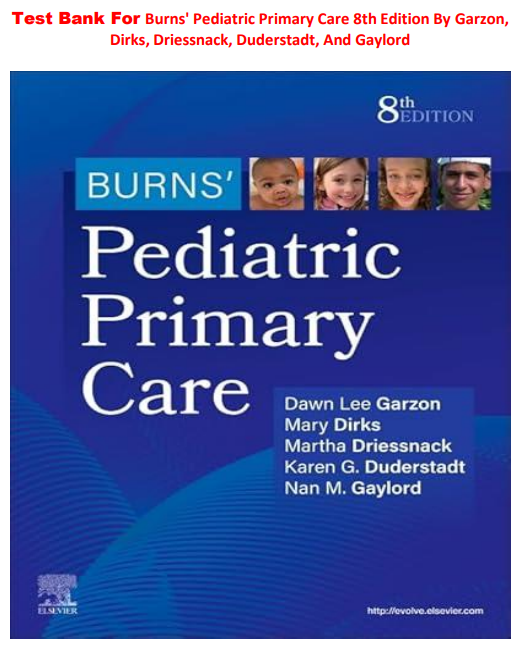
Burns’ Pediatric Primary Care has been the definitive advanced practice resource for this specialty for decades. The 8th edition, led by Garzon, Dirks, Driessnack, Duderstadt, and Gaylord, carries that tradition forward with updated clinical guidelines across every developmental stage and clinical condition, current American Academy of Pediatrics recommendations, expanded content on health equity and social determinants of health in child health, revised immunization schedule content, stronger integration of the evidence base for developmental and behavioral screening, and deeper engagement with adolescent health and mental health in primary care.
This test bank was built to match it. Every question reflects the clinical breadth and developmental precision of the 8th edition — from growth and development surveillance through chronic disease management, from newborn assessment through adolescent anticipatory guidance, from routine immunization counseling through the diagnostic workup of a child presenting with something that does not fit the expected pattern. You practice thinking the way a pediatric primary care NP actually thinks — developmentally, family-centeredly, and with the evidence base driving every decision.
What Is Inside
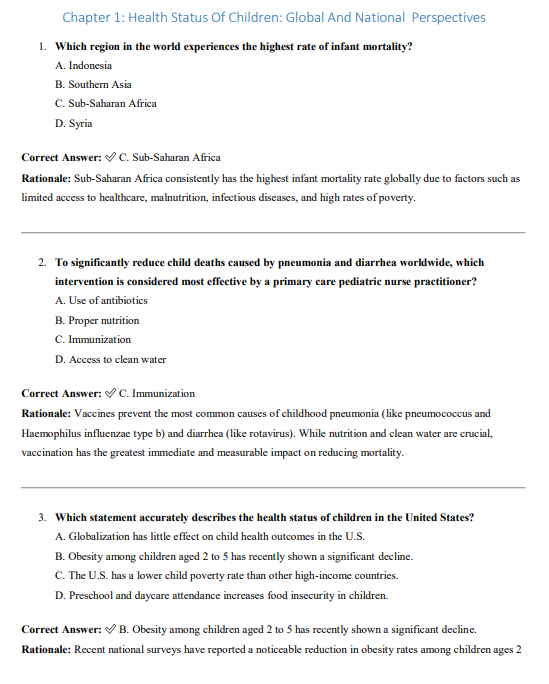
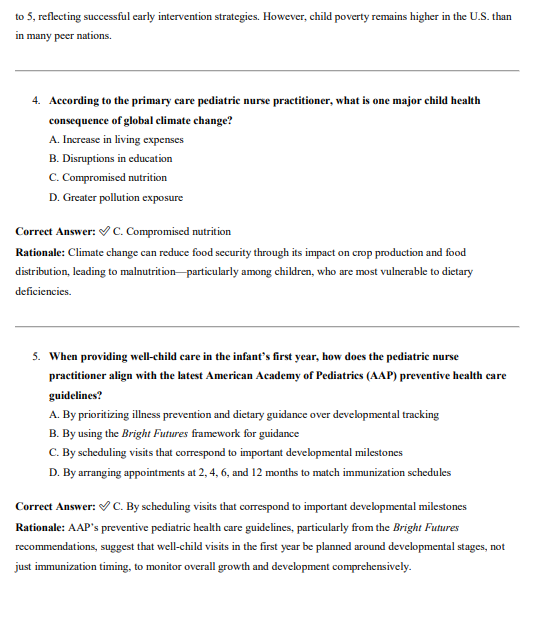
You get over a thousand practice questions covering every major content area in Garzon, Dirks, Driessnack, Duderstadt, and Gaylord’s 8th edition. Questions are written in multiple-choice, select-all-that-apply, and case-based clinical scenario formats — consistent with what you will encounter on advanced practice nursing course exams and the AANPCB and ANCC pediatric nurse practitioner certification examinations.
Every question has a clearly marked correct answer. Every answer includes a full written rationale. The rationale explains the developmental framework, evidence-based clinical guideline, diagnostic reasoning process, or anticipatory guidance principle behind the correct choice and addresses specifically why each wrong option reflects a developmental error, guideline discordance, or clinical misjudgment. At the advanced practice level with pediatric patients, that precision of reasoning is what separates safe, competent practice from practice that misses something critical because it applied adult frameworks to a child.
Topics Covered
The test bank follows the complete structure of Burns’ 8th edition across every major content domain, including:
Foundations of Pediatric Primary Care Practice — the pediatric primary care NP role and scope of practice, family-centered care philosophy and its clinical application, the medical home model and care coordination, health equity and social determinants of health in pediatric primary care, cultural humility in child health practice, interprofessional collaboration in pediatric primary care, preventive care frameworks including Bright Futures, legal and ethical considerations in pediatric practice including consent and assent, confidentiality in adolescent care, and mandatory reporting of child abuse and neglect
Child Development and Developmental Surveillance — theoretical frameworks of child development including Piaget, Erikson, Vygotsky, and Bronfenbrenner, developmental domains including gross motor, fine motor, language, social-emotional, and cognitive development, developmental milestones across all age groups from newborn through adolescence, developmental surveillance versus developmental screening, validated developmental screening tools including the ASQ, M-CHAT-R, PEDS, and Bayley scales, red flags for developmental delay at each age, early intervention referral criteria and process, and autism spectrum disorder screening in primary care
Pediatric Health Assessment — comprehensive and focused health history in pediatric patients, physical examination across developmental stages with age-appropriate techniques, pediatric vital signs and normal values by age, growth assessment including weight, height, head circumference, and BMI with appropriate percentile interpretation, pubertal development assessment using Tanner staging, pediatric pain assessment using developmentally appropriate tools, and documentation of pediatric assessment findings
Well-Child Care and Preventive Services — Bright Futures well-child visit schedule and content by age, newborn visit through adolescent annual visit nursing content, anticipatory guidance topics by developmental stage, lead screening guidelines and interpretation, anemia screening recommendations, vision and hearing screening at each age, blood pressure screening in children, lipid screening in children and adolescents, sexually transmitted infection screening in adolescents, depression screening in adolescents, and substance use screening using CRAFFT and SBIRT
Immunizations in Pediatric Primary Care — current AAP and CDC childhood immunization schedule, vaccine pharmacology and mechanism of action, contraindications and precautions for each vaccine, vaccine-preventable disease epidemiology, management of immunization hesitancy and vaccine refusal, catch-up immunization scheduling, documentation requirements, vaccine storage and handling, and special immunization considerations for immunocompromised and high-risk children
Nutrition in Pediatric Primary Care — breastfeeding promotion and support in primary care, formula selection and preparation guidance, introduction of solid foods including current AAP recommendations, nutrition from toddler through adolescence, iron and vitamin D supplementation guidelines, childhood obesity prevention and management, eating disorders recognition in primary care, and special nutritional needs for children with chronic conditions
Neonatal and Infant Assessment and Care — newborn physical examination findings and their significance, normal versus abnormal newborn screening results, jaundice assessment and management in primary care, newborn feeding support, safe sleep counseling, developmental surveillance in infancy, common newborn conditions managed in primary care, and transition from hospital to primary care
Common Pediatric Acute Conditions — fever assessment and management across ages, upper respiratory infection management and antibiotic stewardship, acute otitis media diagnosis and treatment using current AAP guidelines, otitis media with effusion, pharyngitis including GAS diagnosis and treatment, sinusitis diagnosis and treatment, croup recognition and management in primary care, bronchiolitis assessment and outpatient management, influenza diagnosis and antiviral treatment, COVID-19 in pediatric patients, skin and soft tissue infections, conjunctivitis differential diagnosis and treatment, urinary tract infection diagnosis and treatment in children, and gastroenteritis management including oral rehydration therapy
Pediatric Respiratory Conditions in Primary Care — asthma diagnosis and stepwise management using current NAEPP guidelines, asthma action plan development and education, controller versus rescue medication selection and teaching, cystic fibrosis management in primary care collaboration, recurrent wheezing differential diagnosis in infants, and chronic cough differential diagnosis in children
Pediatric Cardiovascular Conditions in Primary Care — heart murmur evaluation and differentiation of innocent versus pathological murmurs, hypertension in children including diagnosis using age-sex-height percentile tables, referral criteria for pediatric cardiac conditions, Kawasaki disease recognition and referral, and syncope evaluation in children and adolescents
Pediatric Neurological Conditions in Primary Care — headache differential diagnosis and management in children, febrile seizure evaluation and parent counseling, epilepsy management in primary care collaboration, concussion evaluation and return-to-play protocols, tic disorders and Tourette syndrome in primary care, and referral criteria for neurological conditions in children
Pediatric Gastrointestinal Conditions in Primary Care — constipation diagnosis and management including the Rome IV criteria, gastroesophageal reflux disease in infants and children, functional abdominal pain evaluation, celiac disease screening and diagnosis in primary care, inflammatory bowel disease recognition and referral, and abdominal pain differential diagnosis by age
Pediatric Genitourinary Conditions in Primary Care — recurrent urinary tract infection evaluation, voiding dysfunction in children, enuresis assessment and management, labial adhesions, phimosis and paraphimosis, testicular conditions including retractile versus undescended testicle, and menstrual disorder evaluation in adolescents
Pediatric Musculoskeletal Conditions in Primary Care — in-toeing and out-toeing evaluation, flat feet assessment, Legg-Calvé-Perthes disease recognition, Osgood-Schlatter disease management, scoliosis screening and referral criteria, sports physical evaluation, and fracture assessment and referral criteria in primary care
Pediatric Dermatological Conditions in Primary Care — atopic dermatitis diagnosis and management, diaper dermatitis differential diagnosis, impetigo treatment, tinea capitis diagnosis and treatment, molluscum contagiosum management, acne vulgaris stepwise treatment in adolescents, psoriasis recognition, and hemangioma evaluation
Pediatric Endocrine and Metabolic Conditions in Primary Care — type 1 and type 2 diabetes recognition and management in primary care collaboration, prediabetes screening in children, thyroid disorder recognition and referral, short stature evaluation, precocious puberty recognition, delayed puberty evaluation, and polycystic ovary syndrome in adolescents
Pediatric Hematologic Conditions in Primary Care — iron deficiency anemia diagnosis and treatment, sickle cell disease management in primary care collaboration, thrombocytopenic purpura recognition, and referral criteria for hematologic conditions in children
Pediatric Behavioral and Mental Health in Primary Care — ADHD diagnosis using DSM-5-TR criteria and Vanderbilt Assessment Scales, ADHD medication management in primary care including stimulant and non-stimulant options, autism spectrum disorder recognition and co-management, anxiety disorders in children and adolescents, depression screening and management in primary care, disruptive behavior disorders including ODD and conduct disorder, sleep disorders in children, encopresis management, school refusal evaluation, and referral criteria for child mental health conditions
Adolescent Health in Primary Care — HEADSS assessment for adolescent visits, confidentiality in adolescent care and its limits, sexual and reproductive health in adolescents including contraceptive counseling, STI screening and treatment, pregnancy testing and counseling, substance use screening and brief intervention, eating disorder recognition and management in primary care, violence and safety screening in adolescents, and sexual minority youth health considerations
Child Maltreatment and Safety in Primary Care — recognition of physical abuse including concerning injury patterns, sexual abuse assessment including forensic examination referral criteria, emotional abuse and neglect recognition, mandatory reporting obligations, safety counseling including car seat guidance, water safety, firearm safety, and age-appropriate internet and screen use guidance
Who Should Use This
This test bank is the right resource for pediatric nurse practitioner students and family nurse practitioner students whose pediatric primary care course uses Garzon, Dirks, Driessnack, Duderstadt, and Gaylord’s 8th edition, NP students preparing for the AANPCB Pediatric Nurse Practitioner — Primary Care certification examination or the PNCB Certified Pediatric Nurse Practitioner examination, FNP students preparing for certification examinations who want focused practice on pediatric primary care content, advanced practice nursing students who want structured practice in the developmental reasoning and age-specific clinical decision-making that pediatric primary care demands, and nursing faculty teaching pediatric primary care courses who need a developmentally organized, evidence-based, and clinically comprehensive question pool for building course assessments.
Why the 8th Edition Specifically
Pediatric primary care guidelines change constantly and pediatric NPs are expected to practice from the current evidence at all times. The 8th edition of Burns’ incorporates the most current AAP clinical practice guidelines across every major condition, updated childhood immunization schedules, revised developmental screening recommendations, current NAEPP asthma guidelines, updated AAP guidance on obesity, hypertension, and mental health screening in children, expanded content on health equity and addressing structural determinants of child health, and deeper integration of trauma-informed primary care with pediatric populations.
This test bank was written to align with the 8th edition specifically. The clinical guidelines, developmental frameworks, diagnostic criteria, and anticipatory guidance content in the questions reflect what is in this edition. If your NP program uses the 8th edition, this is the test bank that matches it.
5 Sample Questions
Question 1
A pediatric NP is conducting an 18-month well-child visit. The child walked independently at 12 months, has a vocabulary of 8 words, points to objects when named, and engages in back-and-forth play with the parent. The parent asks whether they should be worried because a neighbor’s child the same age is saying 50 words. Which response best reflects evidence-based developmental surveillance?
A. Refer the child immediately for a speech and language evaluation since 8 words at 18 months is significantly delayed
B. Reassure the family that the child’s development is within normal limits — the expected vocabulary at 18 months is at least 5 to 10 words with a range of up to 20, and the child is demonstrating strong social communication and joint attention skills that are the most important developmental indicators at this age
C. Order a hearing test and refer to early intervention since any vocabulary below 50 words at 18 months requires evaluation
D. Advise the parents to reduce screen time and return in three months for a recheck before taking any further action
Correct Answer: B
At 18 months, the developmental expectation for expressive vocabulary ranges from approximately 10 to 20 words, with some variability. More importantly, the quality of communication — joint attention, pointing, back-and-forth social engagement, and receptive language — is often more predictive of developmental trajectory than word count alone. This child is demonstrating strong social communication skills that are reassuring. While a hearing screening is always appropriate at well visits and should be confirmed as current, an immediate referral for speech and language evaluation is not indicated based on this presentation. Comparing to a neighbor’s child reflects parental anxiety rather than clinical concern. The NP should validate the parent’s engagement and provide specific anticipatory guidance about language promotion while confirming that the current trajectory is within normal range.
Question 2
A 7-year-old is brought to the pediatric primary care clinic with a three-day history of sore throat, temperature of 38.9°C, headache, and tender anterior cervical lymphadenopathy. There is no cough. The tonsils are erythematous with exudate. Using the McIsaac clinical prediction score and current AAP guidelines, which management approach is most appropriate?
A. Prescribe amoxicillin immediately since the clinical presentation is highly suspicious for group A streptococcal pharyngitis and empirical treatment is the current standard of care
B. Perform a rapid antigen detection test for group A streptococcus — if positive, prescribe amoxicillin for 10 days; if negative, withhold antibiotics and provide symptomatic care
C. Order a throat culture only since rapid strep tests have insufficient sensitivity to guide treatment in this age group
D. Prescribe azithromycin as first-line therapy since amoxicillin resistance among group A streptococcus has become clinically significant
Correct Answer: B
Current AAP guidelines recommend against empirical antibiotic treatment for pharyngitis without microbiological confirmation of group A streptococcus. This patient scores highly on the McIsaac prediction rule — fever, tonsillar exudate, anterior cervical lymphadenopathy, and absence of cough — warranting testing, but not empirical treatment. A rapid antigen detection test is both sensitive and specific enough to guide management in this age group. If the rapid test is positive, amoxicillin for 10 days is first-line therapy given the ongoing susceptibility of GAS to penicillin-class antibiotics — GAS has not demonstrated clinically significant amoxicillin resistance. If the rapid test is negative in a high-risk patient, a backup throat culture is recommended. Azithromycin is not first-line therapy and carries higher rates of macrolide resistance.
Question 3
During a 9-month well-child visit, a pediatric NP administers the M-CHAT-R and finds that the infant fails two critical items — the child does not point to share interest with others and does not respond consistently to their name being called. The parents report no other concerns and note that the baby is very happy and smiles at familiar faces. Which action best reflects current evidence-based practice for autism spectrum disorder screening?
A. Reassure the parents since smiling and being happy are the most important indicators that autism is not present
B. Document the failed M-CHAT-R items, explain to the parents that these are early indicators warranting further evaluation, administer the M-CHAT-R Follow-Up interview to clarify risk, refer to early intervention for developmental evaluation, and schedule a follow-up visit in one to two months
C. Repeat the M-CHAT-R at the 12-month visit since the tool is not validated for use at 9 months
D. Refer the child directly to a developmental pediatrician and defer any further screening until a formal diagnosis is made
Correct Answer: B
The M-CHAT-R is validated for use between 16 and 30 months, but developmental surveillance for ASD risk should occur at every well-child visit from birth. At 9 months, failure of critical developmental milestones including pointing to share interest and consistent name response are significant early warning signs regardless of the child’s overall affect and social smiling. Early intervention is the evidence-based response — research consistently demonstrates that earlier intervention improves developmental outcomes in children with ASD. The pediatric NP should administer the M-CHAT-R Follow-Up interview, explain the findings to the family in a supportive and non-alarmist way, refer immediately to early intervention services, and maintain close follow-up. Waiting until 12 months to screen or deferring entirely to specialist evaluation delays intervention.
Question 4
A pediatric NP is seeing a 14-year-old female for a sports physical. During the confidential adolescent portion of the visit using the HEADSS framework, the patient discloses that she has been sexually active with one male partner, is not using contraception, and that her last menstrual period was six weeks ago, though her cycles are typically irregular. She asks the NP not to tell her parents. Which approach best reflects ethical and legal principles in adolescent primary care?
A. Inform the parents immediately since the patient is a minor and parental consent governs all aspects of her care
B. Conduct a pregnancy test with the patient’s consent, address her immediate health needs including testing for sexually transmitted infections, provide confidential contraceptive counseling consistent with state minor consent laws, explain the limits of confidentiality clearly but supportively, and maintain the therapeutic relationship while encouraging her to involve a trusted adult
C. Decline to provide any reproductive health services without parental consent since the patient is under 18
D. Document the disclosure in the medical record and inform the patient that all records are accessible to her parents through the patient portal
Correct Answer: B
Adolescent confidentiality in reproductive health is governed by state minor consent laws, which in most jurisdictions allow minors to consent to contraceptive services, STI testing and treatment, and pregnancy testing and counseling without parental involvement. The pediatric NP’s obligation is to provide evidence-based care that addresses this patient’s immediate health needs — pregnancy testing, STI screening, and contraceptive counseling — while being honest and clear about the limits of confidentiality, such as situations involving risk of harm. Automatically involving parents violates minor consent rights in most states and will destroy the therapeutic relationship in ways that discourage future healthcare engagement. Documentation should reflect the care provided without information that would breach confidentiality through the patient portal. The NP should also gently explore the patient’s relationship safety within the context of the visit.
Question 5
A pediatric NP is managing a 6-year-old with moderate persistent asthma who is currently on a low-dose inhaled corticosteroid. The child has been waking up twice per week at night due to coughing and wheezing and has needed the rescue inhaler four times in the past month. The parents report the child missed two days of school last week. Using current NAEPP stepwise guidelines, which management change is most appropriate?
A. The child is well-controlled — continue the current low-dose ICS and reassess in three months
B. Step up therapy by adding a long-acting beta-2 agonist to the current low-dose ICS or increasing to a medium-dose ICS since nighttime symptoms, rescue inhaler use greater than twice per week, and school absences indicate the asthma is not well-controlled
C. Replace the inhaled corticosteroid with a leukotriene receptor antagonist since oral medications are easier for school-age children to use correctly
D. Prescribe a short course of oral corticosteroids and return to the current regimen since this pattern represents a temporary exacerbation rather than uncontrolled asthma
Correct Answer: B
Current NAEPP guidelines define well-controlled asthma as daytime symptoms no more than twice per week, nighttime symptoms no more than twice per month, rescue inhaler use no more than twice per week, and no interference with normal activity. This child’s symptoms — twice-weekly nighttime awakenings, four rescue inhaler uses in one month, and school absences — clearly indicate that the asthma is not well-controlled on the current low-dose ICS regimen. The appropriate clinical response is to step up therapy per the NAEPP stepwise approach, which for this age group includes either adding a LABA to the current ICS or moving to a medium-dose ICS. A short course of oral corticosteroids addresses an acute exacerbation but does not adjust the maintenance regimen. Leukotriene receptor antagonists are generally less effective than ICS as controller therapy and are not the preferred step-up option.
Frequently Asked Questions
Is this the official Elsevier test bank for Burns’ 8th edition?
No. This is an independently developed study resource based on the content of Garzon, Dirks, Driessnack, Duderstadt, and Gaylord’s 8th edition. It is not published or endorsed by Elsevier or the original authors. It is a supplementary exam and certification preparation tool for pediatric NP students and faculty.
How many questions are in the test bank?
There are over a thousand questions distributed across all major developmental stages, clinical conditions, and anticipatory guidance topics in the 8th edition, with strong representation in the highest-yield areas including developmental surveillance, well-child care, acute illness management, immunizations, and pediatric mental health and behavioral conditions.
Can this test bank help me prepare for the PNP-PC certification examination?
Yes. The content in Burns’ 8th edition maps closely to the AANPCB Pediatric Nurse Practitioner — Primary Care certification blueprint, and questions are written at the clinical decision-making and application level that the certification examination demands. It works best as a supplementary resource alongside a dedicated PNP-PC review program.
I am an FNP student. Is this test bank useful for the pediatric content area of my certification examination?
Yes. FNP certification examinations include pediatric primary care content across developmental surveillance, well-child care, acute illness management, and common pediatric chronic conditions. This test bank provides focused, developmentally organized practice across all of those areas.
What makes pediatric primary care NP questions different from general nursing questions about children?
Pediatric primary care NP questions require you to apply developmental context to every clinical decision — the normal finding at one age is pathological at another, and the first-line treatment for a condition may differ based on the child’s age and weight. They also require a prescriber-level understanding of diagnostic decision-making, clinical prediction tools, and current AAP and CDC guidelines. This test bank is written at that level of specificity.
Does every question include a rationale?
Yes, without exception. Every question has a correct answer and a full written rationale that explains the developmental reasoning, evidence-based guideline, or clinical decision-making process behind the correct choice and addresses why each wrong option reflects a developmental error, guideline discordance, or inappropriate clinical judgment for the age group in question.
Can nursing faculty use this to build pediatric primary care course assessments?
Yes. Questions are organized by developmental stage and clinical content area, making it straightforward to build unit exams, case-based assessments, or comprehensive certification preparation examinations appropriate for graduate-level pediatric NP programs.
What file format is the test bank delivered in?
It comes as a digital file, typically in Word or PDF format. You can search by age group, clinical condition, or developmental domain, print specific sections for focused study sessions, and access it across multiple devices. Many NP students organize their study sessions by developmental stage — working through all infant content, then toddler content, and so on — which mirrors how pediatric primary care knowledge is organized clinically.
Is this test bank specific to the 8th edition only?
Yes. It was written to align with the clinical guidelines, AAP recommendations, developmental screening tools, immunization schedule content, and evidence-based practice frameworks of the 8th edition specifically. Pediatric clinical guidelines — including asthma stepwise management, otitis media treatment criteria, and obesity management recommendations — are updated regularly, and earlier editions may not reflect current evidence. Always confirm your edition before purchasing.


Melania Angel –
Helpful questions for preparing throughout the semester
Winnie M. –
A valuable addition to my nursing study materials
Dorcas M. –
Great variety kept my study sessions interesting
Kevin May –
Helped me discover topics I needed to review
Glen M. –
Clear format made practicing quick and simple.
Matthew Taylor –
Useful for reviewing material before exam day.
Mary Lincoln –
Questions were relevant and thoughtfully written.
Amanda Thomas –
Helped make my preparation more consistent.
Helen Christie –
Good resource for practicing concepts repeatedly.
Leo Fernandez –
Perfect
Perpetual Gates –
Convenient way to practice questions independently
Bruno Molino –
Good resource to complement other study materials
Cayte N. –
Helpful practice for reviewing important material.
Youri Nice –
Clear wording makes questions easy to follow
Lucas Gabriel –
Helpful study material for exam preparation
Charlotte Rivera –
Great way to reinforce key information
Benjamin Campbell –
Useful questions for identifying areas needing review
Aurora Hezel –
Straightforward questions make revision less complicated.
Jaqueline M. –
Useful set for practicing concepts at your own pace
Danielle Kayle –
Convenient resource for reviewing material whenever needed.
Harry Peters –
Helpful material for supporting active study habits.
Zoe Jacobs –
Makes exam preparation feel more structured.
Jarrod Bent –
A practical resource for testing knowledge after studying.
Francis Pelosi –
Helpful for reviewing foundational nursing principles.
Jedida Brown –
Helpful material for organizing topic-based revision.
Carol Kay –
Provides extra practice beyond standard study notes.
Ava Reed –
Useful tool for checking progress across subjects.